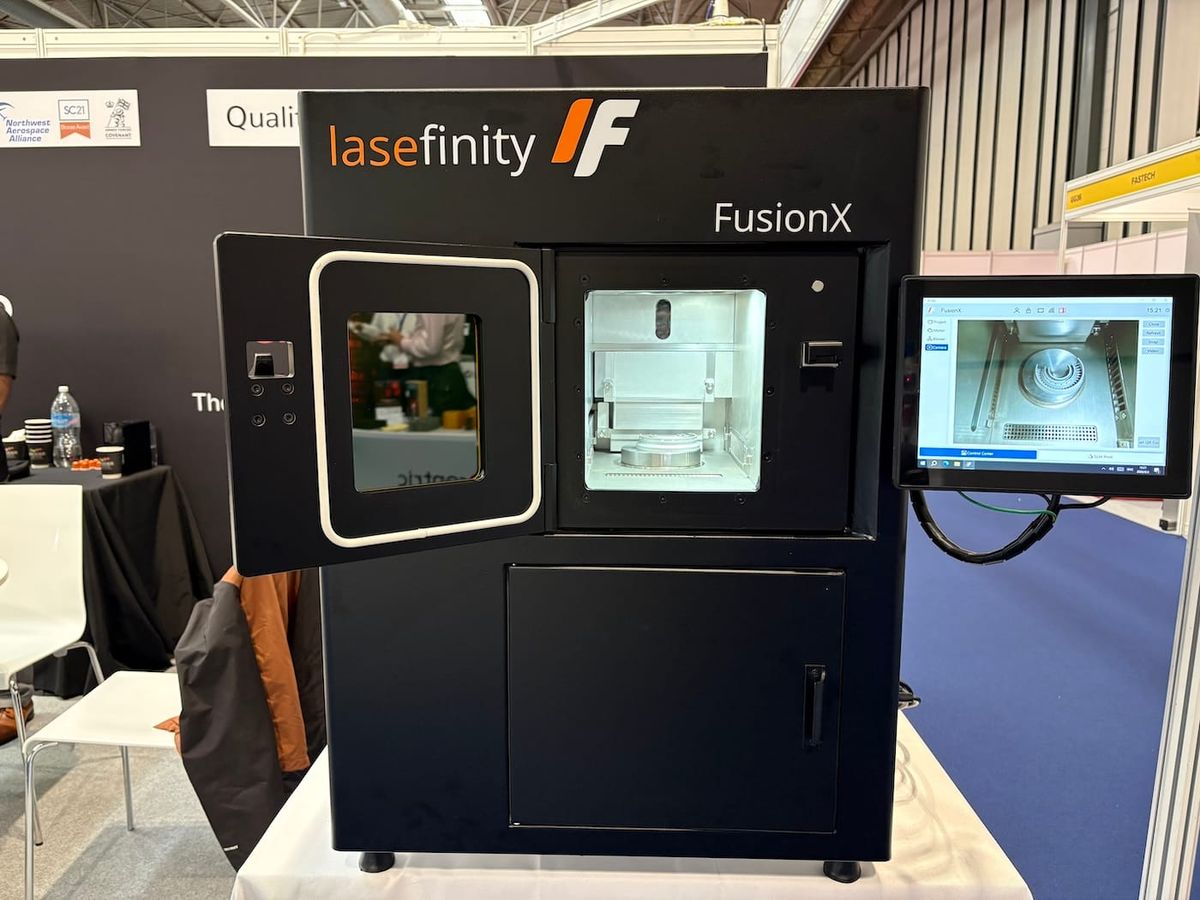
Lasefinity launches FusionX compact desktop metal LPBF printer at TCT 3Sixty for £19,999

Hardware
Originally reported by TCT Magazine
Lasefinity, a Sheffield, UK-based startup formed from Manufacturing Made Easy Ltd, launched the FusionX desktop metal LPBF 3D printer at TCT 3Sixty on June 3, 2026. Priced at an early-bird rate of £19,999 (regular £24,999), the system packs a 500W fiber laser with an adjustable beam spot of 50–200 µm into a 600 × 650 × 860 mm frame, offering a 100 × 100 × 80 mm build volume. The FusionX includes real-time layer monitoring via integrated sensors for laser power, scan speed, chamber atmosphere, and powder spread quality, plus a sealed inert gas chamber, a permanent filtration system rated for 30,000+ hours, and an upper-feed soft blade recoater. Lasefinity CTO Prveen Bidare, a Sheffield Hallam University Senior Lecturer, also introduced a companion wire-feed DED system, the WireX, at the same price point, which uses 0.4–0.8 mm wire feedstock as a safer alternative for academic and vocational training environments. Both machines are open-architecture, compatible with stainless steel, titanium, superalloys, and high-entropy alloys, and allow users to develop custom process parameters, with leasing, renting, and application-development options available.
This launch targets a persistent gap in the metal AM landscape: accessible, low-barrier-entry LPBF for small workshops, university labs, and vocational training centers. The FusionX directly competes with other compact systems like the One Click Metal MPrint (roughly €50,000–€60,000) and the Xact Metal XM200C (around $50,000), undercutting them significantly at its £19,999 early-bird price-while also competing with the broader wave of Chinese desktop metal printers that have pressured Western OEM margins. What distinguishes Lasefinity is its academic pedigree and open-architecture approach: the company explicitly encourages customers to develop their own parameters and maintain the machine themselves via video tutorials and manuals, reducing the post-sale service revenue model that sustains most established OEMs. This service-light, customer-empowerment play fits a market segment where total cost of ownership and maintenance burden are often the real barriers, not the purchase price alone. The WireX companion system further diversifies the offering into DED for institutions that prefer wire feedstock over metal powder handling.
The real test for Lasefinity will not be the launch hype but execution on reliability, powder handling safety at this form factor, and the quality of its self-service maintenance ecosystem. Industrial metal LPBF is notoriously sensitive to process consistency; a desktop system that compromises on inert atmosphere or thermal management can produce scrap parts rapidly. The company’s academic research roots lend credibility to the claimed integrated sensor suite and 30,000-hour filtration, but translating that into field performance across dozens of customer sites is a different challenge. For workshops and training centers evaluating the FusionX, the critical question is whether the open-architecture flexibility outweighs the loss of OEM parameter libraries and certified process recipes-a tradeoff that works well in R&D settings but can frustrate production-oriented users. Lasefinity needs to ship reliably and build a user community fast, because the competition from both Chinese imports and discounted Western refurbs is only intensifying.
Topics