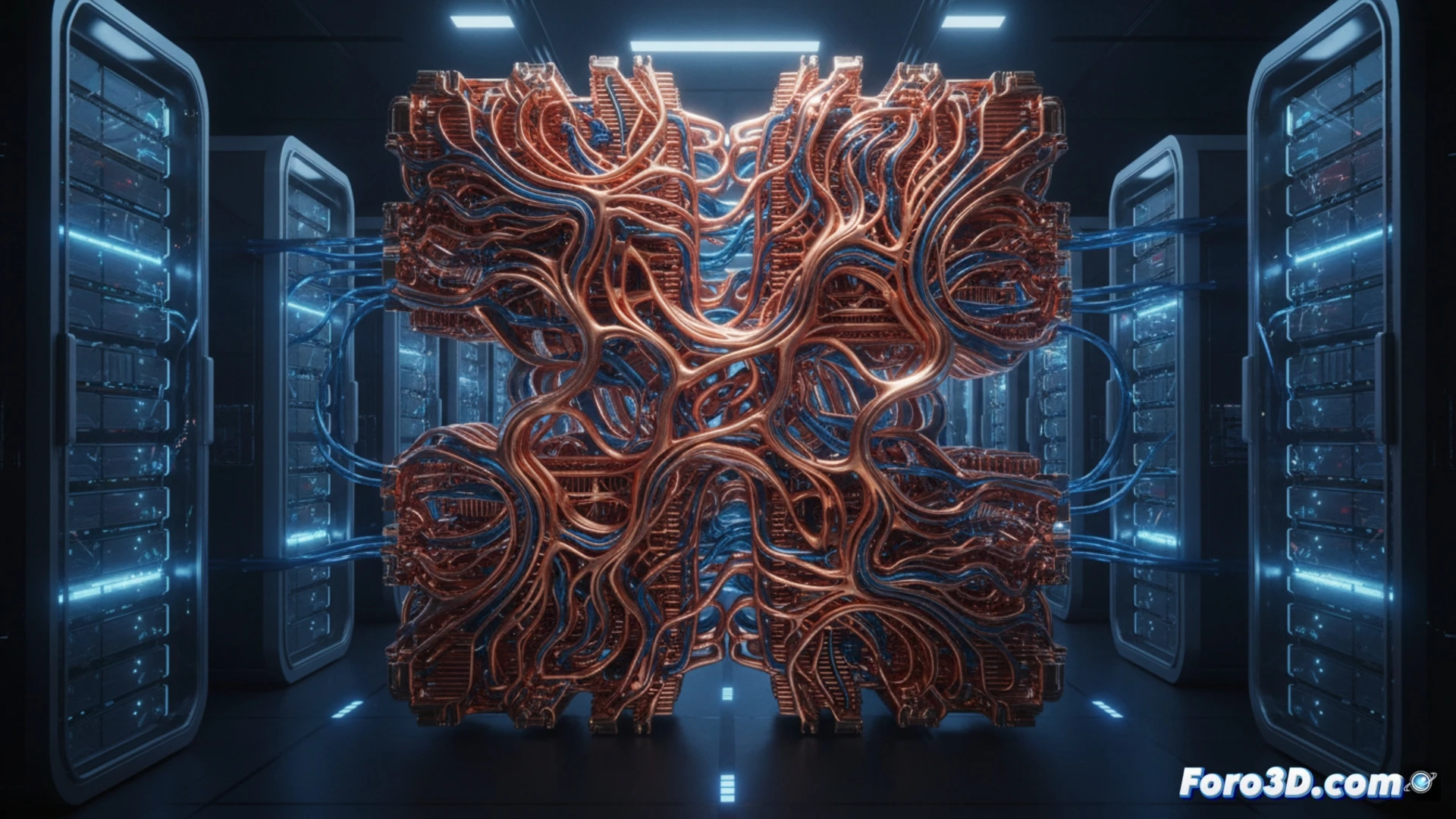
University of Illinois engineers use 3D-printed copper cold plates to cut data center cooling energy by 98%
Originally reported by foro3d.com
Researchers at the University of Illinois Urbana-Champaign have demonstrated a 3D-printed pure copper cold plate that reduces data center cooling energy consumption by 98%, from 30% of total facility energy down to 1.1%. Published in Cell Reports Physical Science, the work uses topology optimization to generate spiked and serrated fin geometries that are impossible to machine conventionally. The team printed the cold plates in pure copper using laser powder bed fusion (LPBF), leveraging copper's high thermal conductivity while overcoming its poor machinability. Computational fluid dynamics simulations showed that the irregular edges induce micro-turbulence in the coolant flow, extracting heat five times more efficiently than straight-fin designs.
This result matters because it directly addresses the thermal bottleneck in data centers, which consume roughly 1-2% of global electricity and where cooling accounts for a third of that load. The work fits the pattern of extreme topology optimization unlocking performance that was previously theoretical but unbuildable - a recurring play where additive manufacturing enables geometries that redefine a component's efficiency ceiling. The use of pure copper in LPBF is notable because copper's high reflectivity and thermal conductivity make it difficult to process reliably; the Illinois team's success suggests that copper AM is maturing beyond niche aerospace and defense applications into high-volume industrial infrastructure. The 5x improvement in heat flux density over planar heat sinks is the kind of step-change that could shift data center architecture from air-cooled to liquid-cooled designs at scale.
From an industry standpoint, the practical next step is translating this lab result into a manufacturable, cost-competitive product. The topology-optimized geometry must be validated under real server loads and production tolerances, and the copper LPBF process must demonstrate repeatability at the volumes data center operators require. For thermal management suppliers, this work signals that the design frontier for cold plates has moved - and that AM-enabled copper geometries are now a credible option worth evaluating in their own R&D roadmaps.
Topics