MX3D Says Framatome Facility Marks ‘New Era’ for Nuclear WAAM 3D Printing

Hardware
Originally reported by 3D Printing Industry
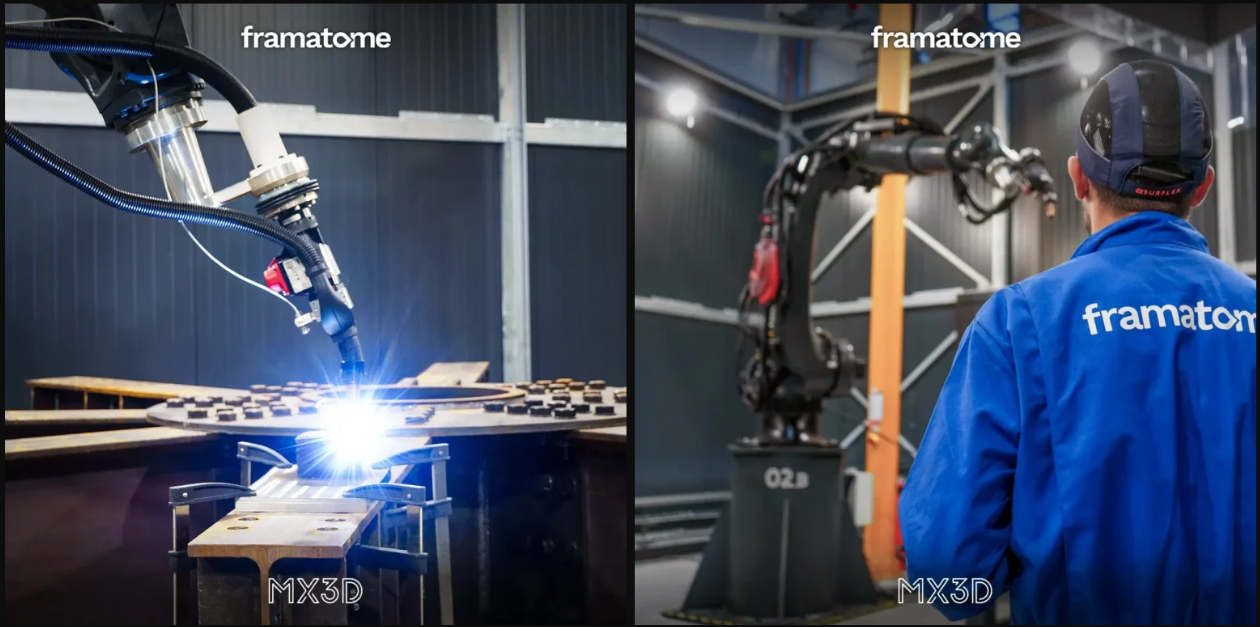
French nuclear engineering firm Framatome has inaugurated a €25 million ($28.6 million) additive manufacturing center in Romans-sur-Isère, France, dedicated to producing metal components for primary nuclear reactor circuits using wire arc additive manufacturing (WAAM) systems supplied by Amsterdam-based MX3D. Named the Amiral Bernard-Antoine Morio de l’Isle Additive Manufacturing Center, the 6,000 m² facility was built from groundbreaking to full operational status in under one year. The center produces components ranging from one-ton impellers to structures between 20 and 25 tons, all with complex geometries that would traditionally require forging. MX3D CEO Gijs van der Velden described the facility as the start of a new era for large-scale additive manufacturing in nuclear energy.
This is the first industrial-scale AM facility in Europe's nuclear sector, representing a significant step beyond MX3D's earlier architectural-scale demonstration - the stainless steel bridge installed in Amsterdam in 2021. The Framatome facility directly addresses the nuclear industry's long-standing qualification grind for safety-critical parts. Notably, Framatome and MX3D spent three years validating WAAM for nuclear applications before the center was announced, meaning the €25 million investment is the production output of a qualification process already completed. The facility also positions itself within the French defense energy industry, wrapping the installation into broader arguments about industrial sovereignty and supply chain security. How much the center actually reduces lead times and material waste against forged equivalents remains unquantified by Framatome, but the commitment to deploy WAAM at this scale in a sector with among the most stringent qualification standards anywhere - nuclear primary circuits - signals a practical maturation of the process.
From the standpoint of industrial AM adoption, the critical test for MX3D and Framatome will now be whether WAAM components can consistently pass the ongoing surveillance audits and periodic requalifications that nuclear primary circuit parts demand over decades of reactor operation. The center's ability to be a repeatable factory, not merely an impressive demo cell, depends on whether its quality-governance infrastructure - documentation, non-destructive evaluation, and traceability - matches the engineering promise of the large-scale deposition process. For the broader WAAM segment, this facility provides a concrete reference case for DED's scale advantage in heavy industrial applications, but only if it sustains production without the kind of programmatic pauses that have plagued earlier large-format AM installations.
Topics