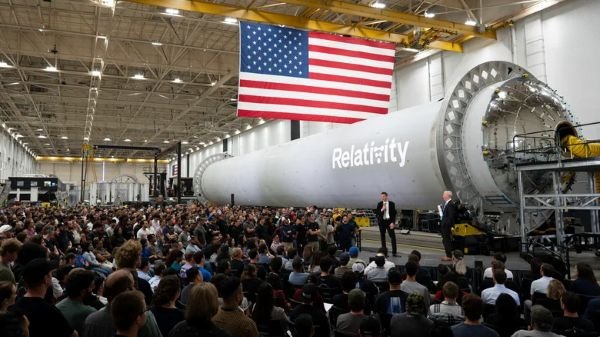
NASA awards Relativity Space Mars orbital mission for 2028

Hardware
Originally reported by nate.com
NASA has awarded Relativity Space a firm-fixed-price contract to launch a Mars orbital mission in 2028, the company announced on June 18. The mission, named 'Terran-1,' will carry four payloads to Mars orbit, collecting data on the planet's atmosphere, dust, and surface. The contract value was not disclosed. Relativity Space, founded in 2015 by Tim Ellis and Jordan Noone, previously launched its first Terran-1 rocket in March 2023 but shifted focus to the larger, reusable Terran R vehicle after that flight. The company has since undergone a restructuring, with former Google CEO Eric Schmidt taking over as CEO and leading a capital raise.
This award marks a significant pivot for Relativity Space, which had been struggling to secure launch contracts after its initial Terran-1 failure. The Mars mission provides a clear, high-profile customer and a concrete deadline, pulling the company out of the speculative phase and into a program-driven execution mode. For the broader AM industry, this is a rare instance of additive manufacturing being directly tied to a deep-space science mission, not just terrestrial satellite launch. It validates the premise that 3D-printed rockets can be trusted for interplanetary payloads, though the real test will be whether Terran R can actually fly on schedule. The contract also underscores NASA's willingness to bet on newer, non-traditional launch providers for science missions, a trend that could open doors for other AM-centric launch startups.
From an AM industry perspective, this is a high-stakes qualification event. Relativity Space must now deliver a flight-ready Terran R and integrate four payloads within 24 months - a timeline that would test any aerospace prime, let alone a company still recovering from a failed first launch. The practical question is whether the company's additive manufacturing infrastructure can scale from prototype to production-grade rocket hardware under program pressure. If successful, it will be the strongest proof point yet for AM in large-scale aerospace structures. If it slips, the technology risk narrative will harden. Either way, the next two years will be decisive for Relativity Space and for the credibility of 3D-printed launch vehicles.
This article is an AI-assisted rewrite of the linked source report. Facts originate from the source; phrasing is AMPulse's. Use Read Original below to verify, or Report an issue if something is wrong.