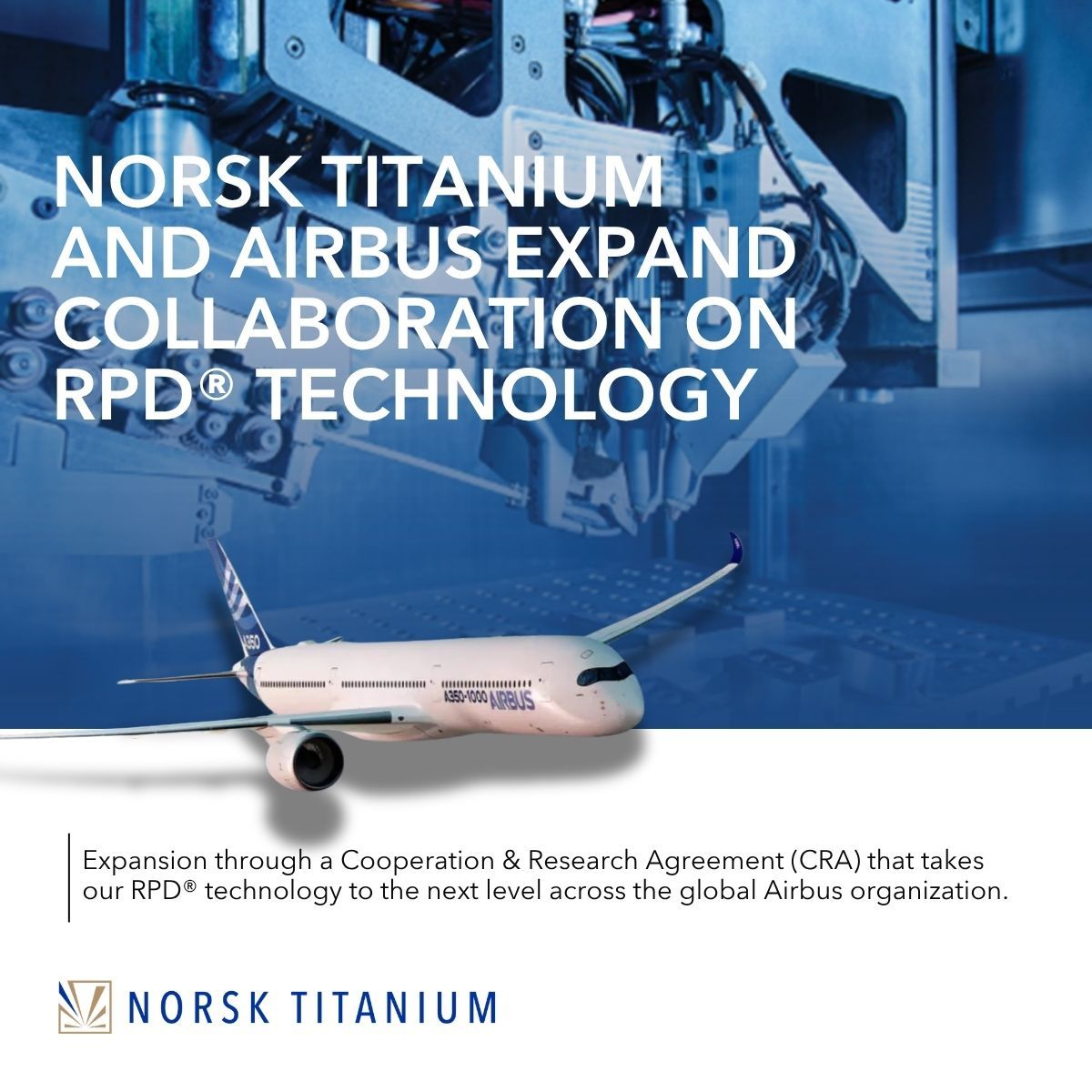
Norsk Titanium signs Cooperation & Research Agreement with Airbus to industrialize RPD for structural titanium parts

Hardware
Originally reported by 3D Printing Industry
Norsk Titanium has signed a Cooperation & Research Agreement (CRA) with Airbus, moving their relationship from program-specific supply into a structured, multi-year industrialization effort. The agreement targets qualification of Norsk Titanium's proprietary Rapid Plasma Deposition (RPD) technology for fatigue-critical structural titanium parts, building on the recent FAA and EASA certification of the A350 Lower Frame Fitting - the largest and highest-classification additively manufactured aerostructure component to receive dual regulatory approval. The CRA is organized around four work packages addressing technology scaling, material and process qualification, and material expansion beyond titanium, with Norsk Titanium working directly with Airbus's DED project team across engineering, airworthiness, and operations at the Saint Eloi and Varel plants. Fabrizio Ponte, CEO of Norsk Titanium, stated that the agreement represents an additional endorsement of RPD technology and another step toward expanding adoption across commercial aircraft programs.
This agreement reflects the strategic reality that the entire wire-DED sector is navigating: in aerospace, the gap between a functional printed part and a flight-certified structural component is measured in years, not months. The CRA elevates two prior discrete collaborations - a 2024 Master Supply Agreement for A350 production support and a joint DED process documentation effort at Varel - into a single, comprehensive industrialization framework. The objective is not a single qualified part but the embedding of RPD into Airbus's material, process, and industrial standards, a prerequisite for repeatable, program-wide use. This matters because the aerospace qualification grind remains the central barrier to AM adoption in the sector, and Norsk Titanium is now positioned to turn a certified part into a certified process, moving from proof to production infrastructure.
For the industry, the practical takeaway is that Norsk Titanium has secured a structured pathway to embed RPD into Airbus's supply chain, but execution on the four work packages will determine whether this becomes a repeatable template or a single-program success. The company must now standardize titanium wire specifications, validate industrial processes at scale, and align all outputs with Airbus's internal requirements - a multi-year effort that will test whether wire-DED can deliver the cost, lead-time, and material savings that aerospace demands. The direction of travel is clear, but the distance remains significant.
This article is an AI-assisted rewrite of the linked source report. Facts originate from the source; phrasing is AMPulse's. Use Read Original below to verify, or Report an issue if something is wrong.