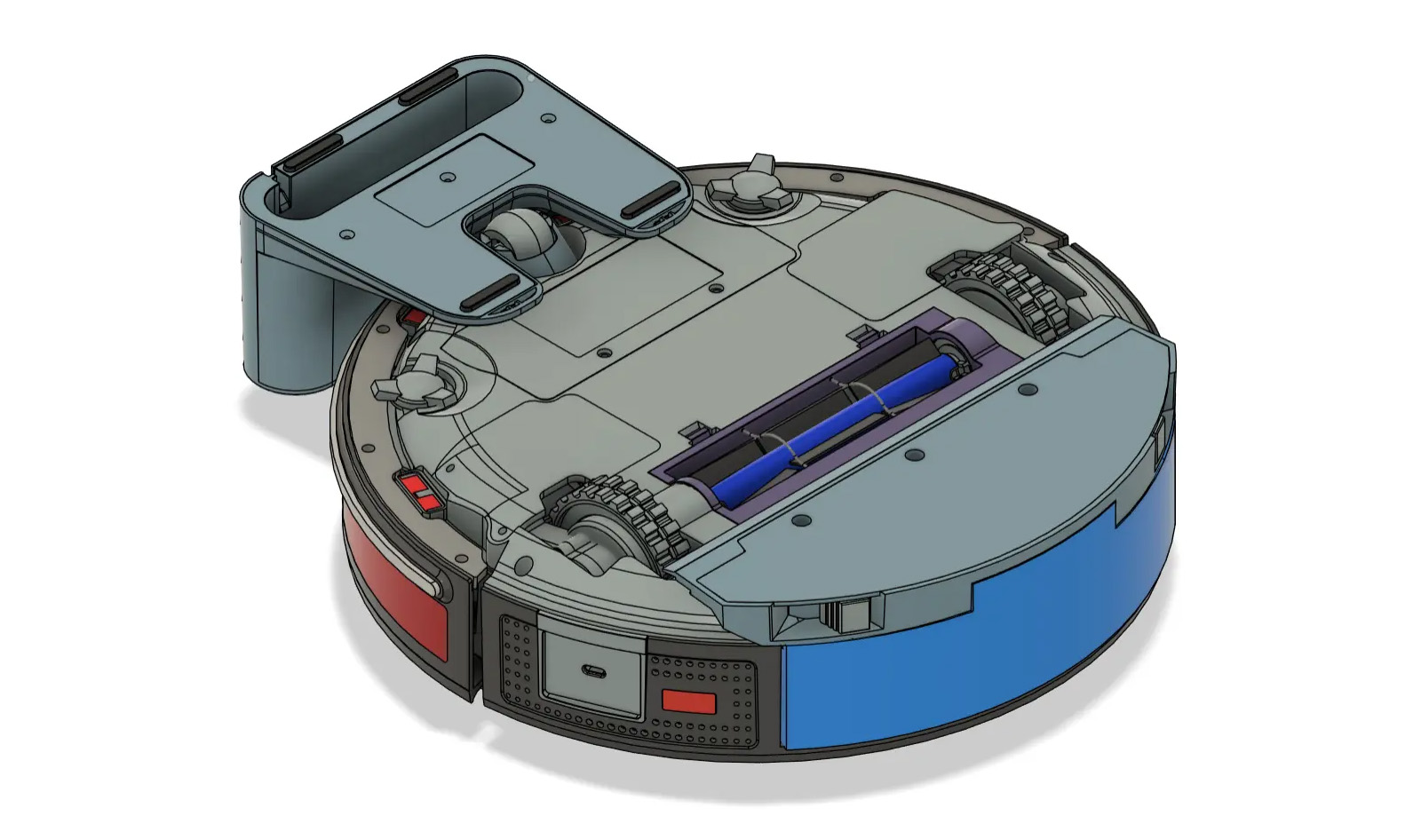
oomwoo launches open-source 3D-printed vacuum robot with ROS 2 and Raspberry Pi

Hardware
Originally reported by 3Druck
Developer Ilia O. has introduced oomwoo, an open-source vacuum robot project whose chassis and mechanical components are designed for FDM/FFF 3D printing. The robot uses a 2D LiDAR for mapping, runs ROS 2 and Nav2 for autonomous navigation, and is controlled locally via Home Assistant without cloud dependency. The initial v0 milestone targets a functional minimal build with a printed chassis, Gazebo simulation, manual SLAM, and ROS 2 on a Raspberry Pi 5, with an ESP32 and micro-ROS under consideration. All code is released under Apache 2.0, with hardware files to follow under a free license.
This project sits at the intersection of the maker and prosumer polymer AM segment and the broader open-source hardware movement. While consumer vacuum robots are a mature market dominated by closed ecosystems from iRobot, Roborock, and Dreame, oomwoo addresses a niche but persistent demand for repairable, locally-controlled appliances. The project's modular design and explicit focus on printability of mechanical parts - including the dustbin, blower unit, and volute housing - aligns with the growing repair and right-to-repair sentiment in the polymer AM community. It does not represent a commercial threat to established players, but it does demonstrate how FDM/FFF can enable functional end-use parts for household robotics when combined with accessible electronics and open-source software stacks.
For the AM industry, oomwoo is a modest but instructive case study in how desktop FDM/FFF can move beyond trinkets and brackets into electromechanical systems integration. The project's success will depend on community adoption, the quality of its documentation, and whether the printed mechanical parts achieve the stated household-appliance durability. It is not a market signal, but it is a useful reference for makers and educators exploring the boundary between 3D printing and robotics.
Topics