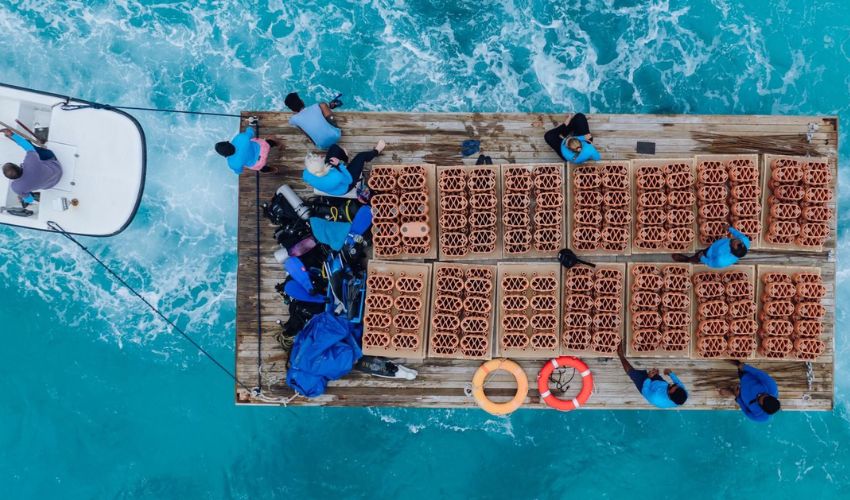
rrreefs Installs 13 3D-Printed Clay Coral Reef Modules at Maldives Resort

Application
Originally reported by 3DNatives
Swiss coral restoration specialist rrreefs has installed 13 3D-printed clay reef structures, named "Theyra Maa" (Dhivehi for "13 flowers"), in the lagoon of the Anantara Dhigu resort in the Maldives. The modules, produced via large-format clay extrusion, feature micro-cavities between printed layers designed to shelter coral larvae from predators and promote biofilm formation. The project is funded by Edelweiss Air and the help alliance foundation, both part of the Lufthansa Group, marking rrreefs' first direct collaboration with a hospitality operator. Since its founding in 2020, the company has supported the growth of over 15,000 new corals through its installed barriers.
This installation sits at the intersection of additive construction and ecological restoration, a niche but growing application segment that leverages AM's geometric freedom to create complex, biologically optimized substrates. Unlike standard concrete reef balls or metal frames, rrreefs' clay structures are designed with specific porosity and flower-like geometry that generates micro-vortices to aid larval settlement. The project updates the ongoing debate about whether AM can deliver cost-effective, scalable solutions for climate-vulnerable ecosystems, moving beyond proof-of-concept into repeatable deployments tied to tourism revenue streams. The partnership with a resort chain and airline group also demonstrates a service-led model where AM-enabled restoration is bundled into corporate sustainability programs, a pattern that could unlock recurring funding for similar projects in coastal zones.
For rrreefs, the practical next step is to demonstrate measurable coral colonization rates and structural durability over multiple monsoon seasons, data that will determine whether hospitality-funded reef restoration becomes a repeatable revenue line or remains a one-off CSR project. The company must also prove that its clay extrusion process can scale beyond bespoke installations without losing the biological performance that justifies the premium over conventional methods. Buyers in the tourism sector should treat this as a promising pilot, not a turnkey solution, and demand long-term monitoring commitments before scaling similar investments.
Topics