POSTECH doubles adhesion strength by controlling 3D-printed metal surface roughness
Originally reported by etnews.com
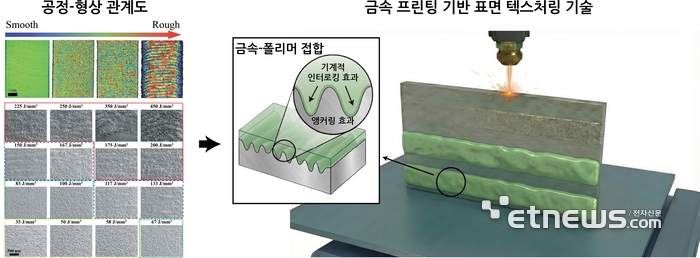
POSTECH researchers led by Professor Hyungsub Kim of the Department of Eco-Friendly Materials Science have developed a method to control surface roughness on laser powder bed fusion (LPBF) printed titanium alloy (Ti-6Al-4V) parts, achieving a twofold increase in metal-polymer adhesion strength. By adjusting laser power, scan speed, and hatch spacing, the team can tune surface roughness across a 20 to 70 micrometer range, and even apply spatially varying roughness within a single component. In tests with PDMS - a silicone polymer used in soft robotics and microfluidics - the optimized rough surface produced adhesion more than double that of a smooth surface, without any chemical treatment. The research was published in Virtual and Physical Prototyping and supported by Korea's National Research Foundation, Defense Acquisition Program Administration, and Ministry of Trade, Industry and Energy.
This work reframes a persistent manufacturing challenge - the rough surface finish inherent to LPBF - as a designable asset rather than a defect to be removed. The mechanism is purely mechanical: micro-scale protrusions and cavities on the metal surface create interlocking with the polymer, analogous to hook-and-loop fasteners, while also increasing contact area. For industries like soft robotics, medical implants, and automotive hybrid structures, this eliminates the need for separate chemical etching or adhesive primers, which are difficult to apply on complex internal geometries. The ability to spatially pattern roughness opens the door to functionally graded metal-polymer interfaces within a single part, a capability that existing surface treatment methods cannot easily replicate. This aligns with the broader trend of using AM process parameters themselves as a design variable, rather than treating surface finish as a post-processing problem.
From a practical standpoint, this is a process-integration advance rather than a breakthrough in materials science. The key question is whether the adhesion levels achieved - roughly double that of smooth surfaces - meet the qualification thresholds for specific applications, particularly in medical devices where bond reliability under cyclic loading and sterilization is critical. POSTECH has demonstrated the concept; the next step is application-specific validation with industry partners in soft robotics or implantable devices. For AM users, this suggests that surface texture design should be considered at the print preparation stage, not left to post-processing.
Topics