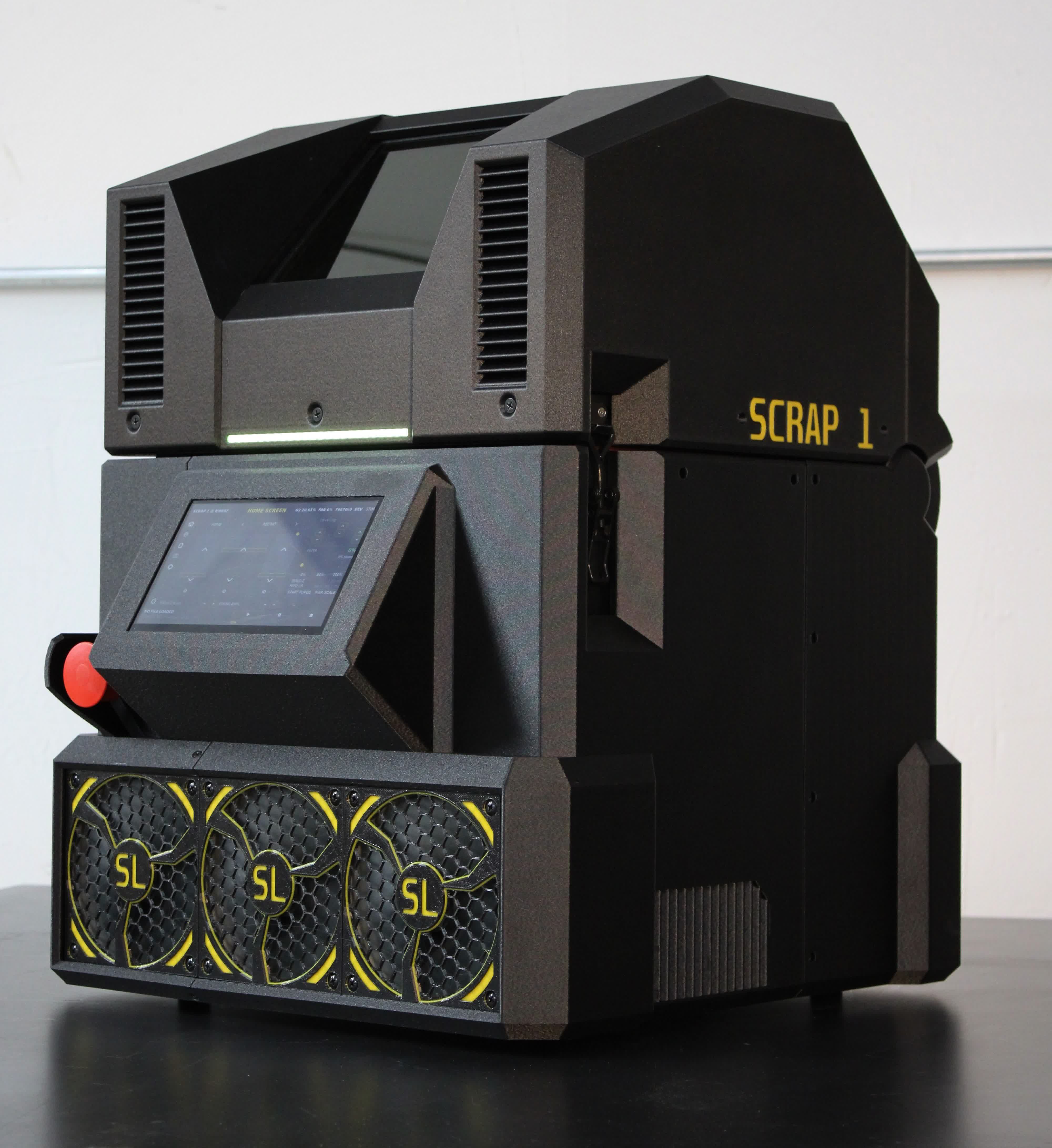
ScrapLabs launches Scrap 1 desktop metal LPBF printer at $9,600, targeting benchtop industrial AM

Hardware
Originally reported by cnbeta.com.tw
Colorado-based startup ScrapLabs has unveiled the Scrap 1, a desktop metal laser powder bed fusion (LPBF) 3D printer priced at $9,600 for a kit version during a limited launch period, rising to $14,200 after April 30, 2026. The fully assembled unit starts at $17,990. Announced at the Rocky Mountain RepRap Festival on April 18-19, 2026, the system integrates liquid and air cooling with HEPA filtration, supports materials including stainless steel, tool steel, copper, nickel alloys, and cobalt-chrome, and connects via Ethernet, Wi-Fi, or USB with a web-based interface. The firmware is based on Klipper, and slicing is compatible with PrusaSlicer, OrcaSlicer, or ScrapLabs' own ScrapSlicer. The company completed proof-of-concept in December 2025, is currently in alpha testing with early partners, plans beta testing in late 2026, and aims for initial US shipments in mid-2027.
This launch targets a persistent gap in the metal AM market: sub-$20,000 LPBF systems that do not require dedicated industrial facilities. Traditional LPBF machines start above $200,000 and demand specialized power, climate control, and powder handling infrastructure. Even lower-cost metal systems from competitors like Desktop Metal (now under Arc Impact after Chapter 11) or One Click Metal typically remain in the $50,000–$100,000 range and assume lab-grade installation conditions. ScrapLabs is attempting to replicate the desktop polymer-to-metal transition seen with Bambu Lab and Prusa in FDM/FFF, but with LPBF's higher process complexity. The target users-university labs, vocational schools, small manufacturers, racing shops, and design studios-currently rely on service bureaus for metal parts. By offering an open toolchain and familiar slicing software, ScrapLabs aims to reduce switching costs for users migrating from polymer desktop printing. The company's success hinges on whether it can deliver part consistency, material properties, and operational safety comparable to industrial systems at a fraction of the footprint and price.
For the AM industry, the Scrap 1 represents a genuine attempt to broaden LPBF access beyond the aerospace qualification grind and high-end tooling shops. The practical test will be whether ScrapLabs can achieve reliable process control and material certification at this price point, especially given the thermal management and powder handling demands of LPBF. Buyers should treat the 2027 delivery timeline and alpha-stage results as early indicators, not production-ready guarantees. The company must now execute on beta testing, supply chain scaling, and customer support-areas where many desktop metal AM efforts have stumbled.
This article is an AI-assisted rewrite of the linked source report. Facts originate from the source; phrasing is AMPulse's. Use Read Original below to verify, or Report an issue if something is wrong.
Topics