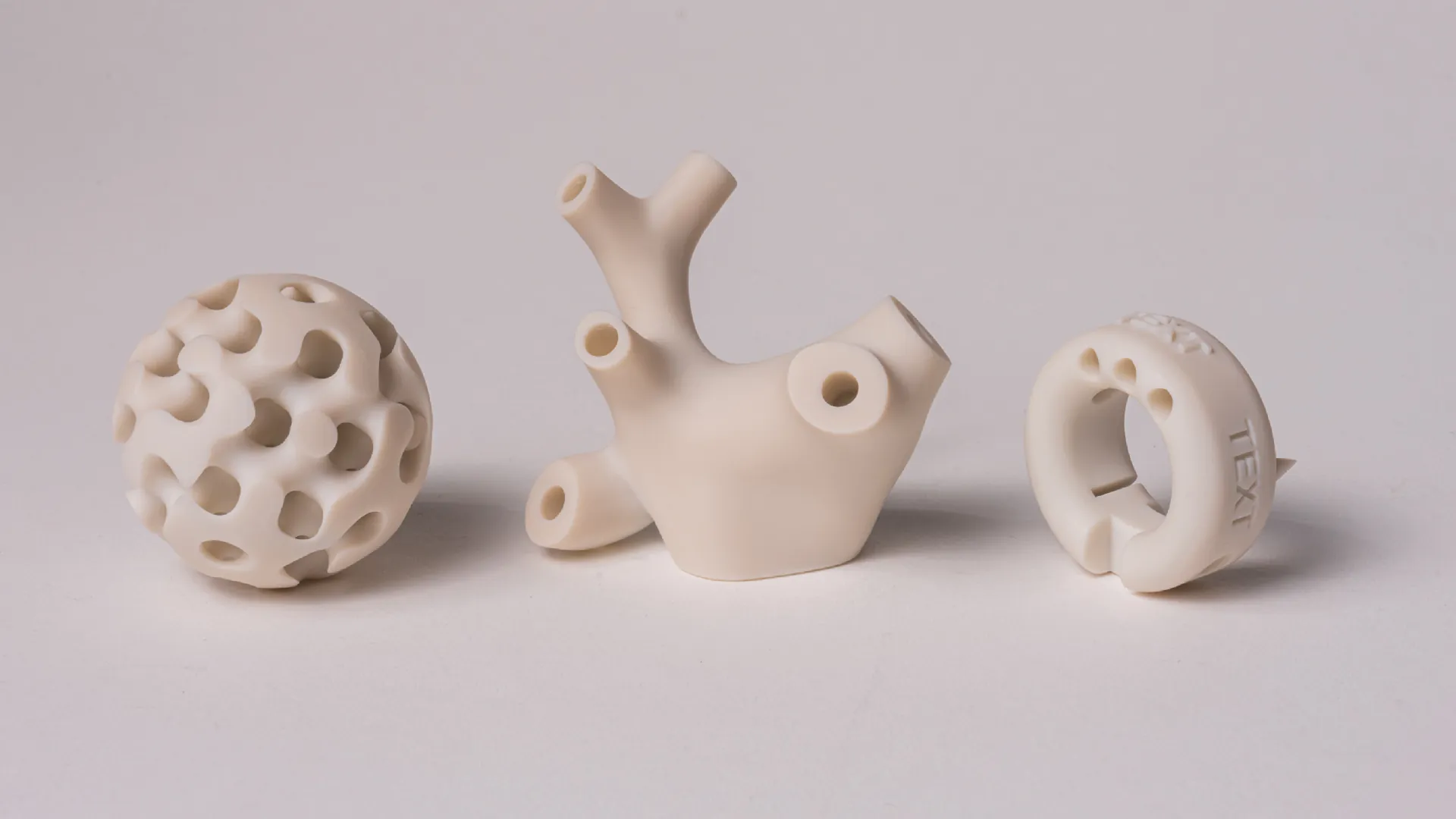
Protolabs adds Medical White biocompatible resin to Hi-Speed SLA lineup on Axtra3D Lumia X1

Platform
Originally reported by 3D Printing Industry
Protolabs has begun offering Medical White (MED-WHT 10), a biocompatible photopolymer, through its on-demand production services, running on Axtra3D's Lumia X1 Hi-Speed SLA system. The material is the fifth production-ready option in Protolabs' Lumia X1 lineup, which currently operates across three units serving industrial and healthcare orders. Medical White meets ISO 10993-5 cytotoxicity and ISO 10993-10 sensitization/irritation standards, targeting regulated end-use parts such as surgical guides, splints, diagnostic components, anatomical models, and dental hardware. The resin also claims fine feature reproduction, dimensional stability, smooth surface finish, and heat resistance, paired with the throughput of Axtra3D's Hybrid PhotoSynthesis (HPS) process.
This launch reflects a broader industry shift toward qualified material ecosystems as a route to production-grade polymer AM. Rather than developing chemistry in-house, Axtra3D sources resins from partners and validates each workflow under its Axtra Solutions model, a strategy that mirrors moves by other resin platform vendors to reduce qualification friction for regulated applications. For Protolabs, adding a biocompatible SLA material to its service bureau catalog strengthens its position in medical-dental production, a vertical where speed-to-qualification and material traceability are critical. The collaboration also highlights how service bureaus are becoming key conduits for validating new materials at commercial scale, bridging the gap between material suppliers and end users who lack in-house qualification resources.
From a practical standpoint, this is a measured but useful expansion of Protolabs' production SLA capabilities. The real test will be order volume and repeatability: whether Medical White parts consistently pass biocompatibility audits across multiple builds. For buyers in medical device manufacturing, this reduces the need to qualify a new material workflow internally, provided Protolabs maintains documented process controls. It is a step forward in service-led adoption, not a breakthrough, but a solid one for regulated polymer parts.
Topics