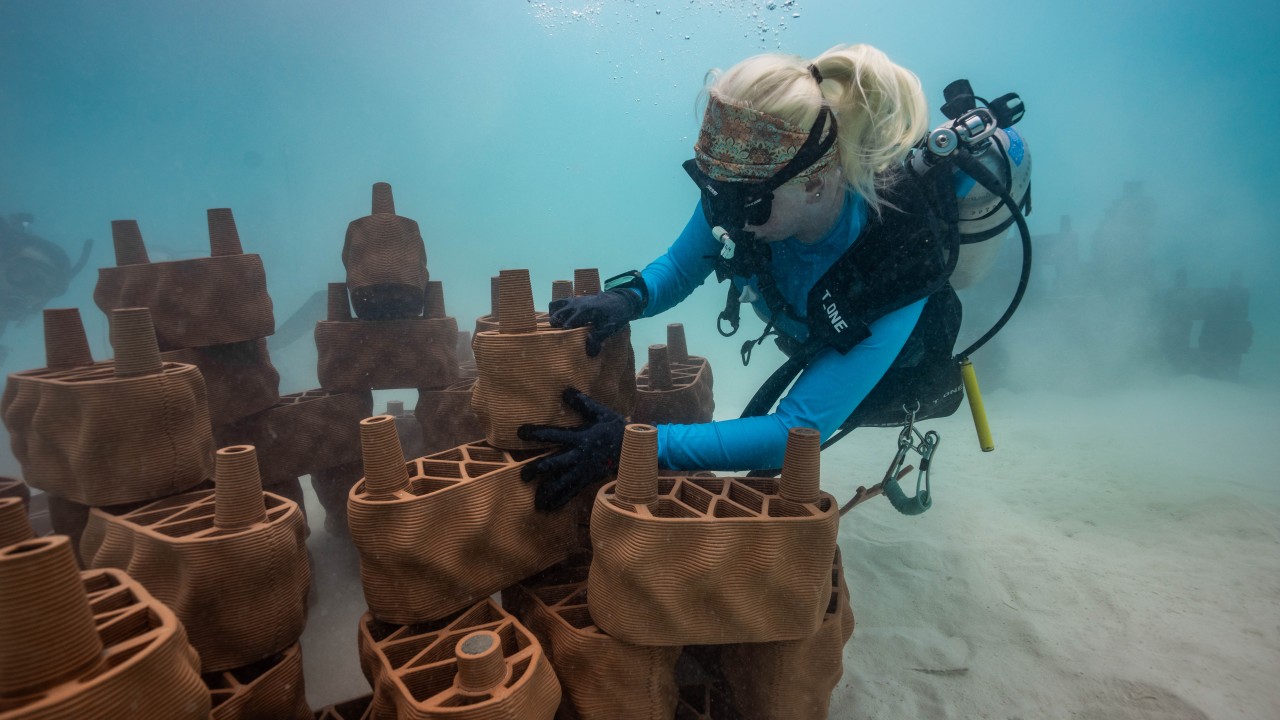
rrreefs Installs 13 3D Printed Clay Reef Structures at Anantara Dhigu Maldives Resort

Application
Originally reported by 3D Printing Industry
Swiss reef restoration company rrreefs has installed 13 flower-shaped, 3D-printed fired terracotta clay reef structures on the lagoon floor of the Anantara Dhigu Maldives Resort in South Malé Atoll. The project, named Theyra Maa, is the first commercial resort partnership for rrreefs, co-funded by Edelweiss Air and help alliance, both part of the Lufthansa Group. The structures feature a proprietary porous clay microstructure designed to promote coral larval settlement, biofilm formation, and predator protection, with steel reinforcement and minimal concrete for stability. The scientific team includes Co-Founder Josephine Graf, Marine Ecologist Dr. Julia Spaet, and Dr. Gerrit Nanninga from Ludwig Maximilian University of Munich.
This installation is a meaningful proof point for the intersection of additive manufacturing and marine conservation-a niche but growing vertical that has seen sporadic activity from academic labs and small startups but rarely attracts commercial hospitality funding. Unlike most 3D-printed reef projects that use concrete or polymer-based materials, rrreefs’ fired clay approach leverages natural porosity and surface chemistry similar to natural reef substrates, addressing a biological effectiveness gap that has limited earlier artificial reef programs. The involvement of a tier-one resort chain and airline corporate social responsibility budgets signals that the conservation economy can absorb modest AM service revenue at scale. For context, global artificial reef spending is estimated at several hundred million USD annually, but AM-enabled projects currently represent a fraction of that, making this a proof of commercial viability rather than a volume play.
The next hurdle for rrreefs is proving biological outcomes-measurable coral coverage and biodiversity indices over a 24–36 month monitoring cycle-since resort partnerships will renew based on visible results, not installation counts. The company must also demonstrate that its clay production process can scale beyond bespoke batches of a few hundred modules without losing the microtexture that drives larval adhesion. For the broader AM community, this project reinforces that material choice matters more than print speed in environmental applications: fired clay, not advanced polymers metals, is the substrate that marine biologists actually want on the seafloor.
This article is an AI-assisted rewrite of the linked source report. Facts originate from the source; phrasing is AMPulse's. Use Read Original below to verify, or Report an issue if something is wrong.
Topics