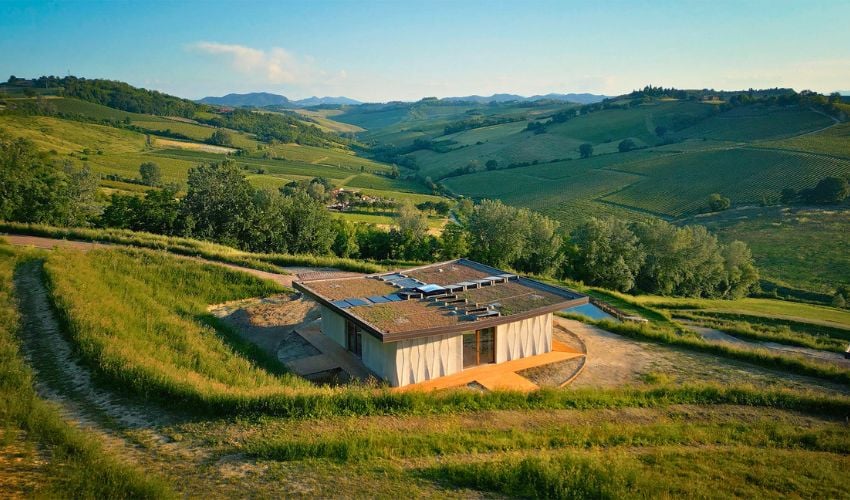
WASP and Olfattiva open Shamballa, a 3D-printed farm and research site in Italy

Hardware
Originally reported by 3DNatives
On June 8, 2026, in the hills of Emilia-Romagna, Italy, WASP and Olfattiva unveiled Shamballa, an open-air laboratory where 3D-printed architecture, medicinal agriculture, and environmental restoration operate on a single site. The centerpiece is Itaca, a self-sufficient farm produced by WASP 3D Build, printed using the Crane WASP system. This construction-scale printer uses four robotic arms on a hexagonal frame to complete a structural shell in days. The walls, 60-70 cm thick, are made from a mixture of natural hydraulic lime (NHL) and Geolegante mineral binder, chosen for its lower carbon emissions and high breathability. The walls are filled with rice husk from agri-food waste, creating internal insulation that achieves a net-negative CO₂ balance. The structure also meets Italian seismic regulations, among the world's most stringent, strengthening the model's case for replication.
Shamballa is positioned as a working reference for sustainable living, integrating 3D-printed architecture with regenerative systems. The site hosts R&D facilities for international researchers in architectural 3D printing and bio-construction, testing complementary systems like automated gardens, rainwater harvesting, and micro-circular economy models. Alongside WASP, Olfattiva runs an eight-hectare medicinal botanical garden, established through reforestation and agroforestry, now hosting over 500 fruit trees from ancient local varieties and 50,000 aromatic and medicinal plants. The garden serves as a community resource, open to local visitors through sensory workshops and educational programs. This project demonstrates a practical, replicable model for combining additive manufacturing with environmental restoration, moving beyond isolated construction demonstrations.
For the AM industry, Shamballa represents a rare, integrated demonstration of how construction-scale 3D printing can be paired with ecological restoration and community engagement. WASP's Crane system, with its multi-arm, large-format capability, is well-suited for this kind of application, but the real test will be whether the project can be replicated at scale and cost-effectively elsewhere. The inclusion of seismic compliance and net-negative carbon materials is a strong technical signal, but the broader adoption of such models depends on regulatory acceptance and the availability of local, sustainable materials. The project is a concrete step toward showing that AM can serve as a tool for sustainable habitat creation, not just industrial production.