WASP unveils outdoor 3D printing research hub 'Shamballa' for sustainable living, set to open spring 2026

Hardware
Originally reported by ShareLab
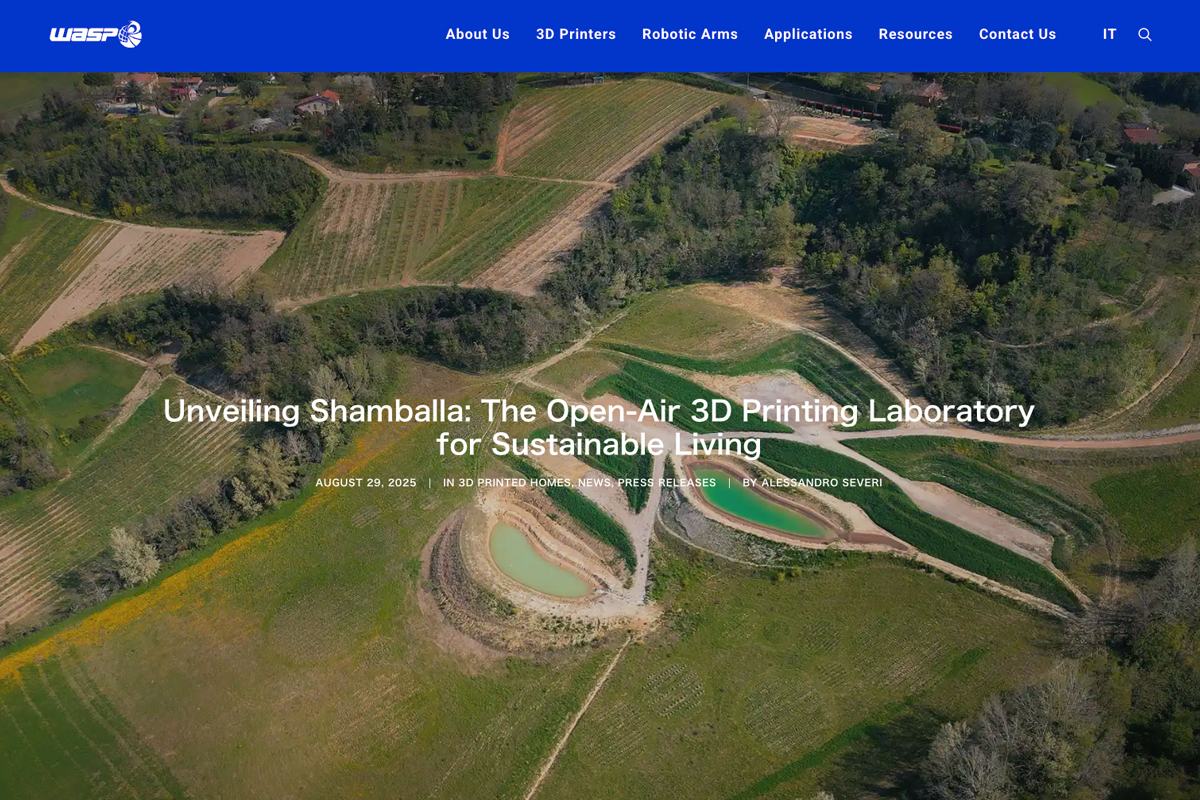
Italian construction 3D printing manufacturer WASP has announced the progress of its 'Shamballa' open-air research project, a sustainable living demonstration site in the hills of northern Italy. The facility spans approximately 8 hectares and has received over €1 million (about $1.1 million) in investment. The first structure to be built on the site is 'Itaca,' a self-sufficient 3D-printed farm designed to achieve near-complete autonomy in water, energy, and food. Shamballa is scheduled to open to the public in spring 2026, and will include a conference hall with a green roof for educational programs and collaborative projects with international companies and research institutions.
This project extends WASP's long-running Shamballa concept, first announced in 2016, which uses the company's Crane WASP construction printer to build with locally sourced natural materials. Unlike many construction AM demonstrations that focus solely on building speed or cost reduction, Shamballa integrates agroforestry, medicinal plant cultivation, and biodiversity restoration across its 8-hectare site. This positions the project as a holistic testbed for circular living models rather than a pure construction technology showcase. The involvement of Olfattiva for land management and WASP 3D Build for construction execution reflects a deliberate pairing of AM capability with agricultural and ecological expertise, a combination rarely seen in the construction AM segment.
For the construction AM industry, Shamballa represents a shift from asking 'what can we print' to 'what kind of living environment can we enable.' WASP's approach here is not about scaling machine sales but about proving a repeatable, integrated model for off-grid or ecologically sensitive communities. The practical test will be whether the site can demonstrate genuine self-sufficiency metrics - energy capture, water recycling, food yield per hectare - that could be replicated in other regions. If successful, Shamballa could serve as a reference for humanitarian housing, disaster relief, or rural development projects where construction AM is paired with regenerative land use.
Topics