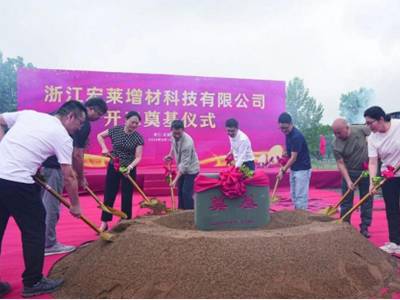
Zhejiang Honglai AM Technology breaks ground on ¥115 million MIM metal additive manufacturing facility in Longyou
Application
Originally reported by cnpowder.com.cn
Zhejiang Honglai AM Technology Co., Ltd. (浙江宏莱增材科技有限公司) has broken ground on a ¥115 million production facility in Longyou County, Zhejiang Province, China. The 20-mu (approx. 1.33-hectare) site will focus on Metal Injection Molding (MIM) and will house an annual capacity of 1,750 tonnes of metal additive manufacturing components and 500 tonnes of metal 3D printing feedstock. The project, backed by parent company Fujian Delnuo New Material Technology, is set to achieve ¥145 million in annual sales revenue and ¥6 million in local tax revenue upon full operation. Core equipment lines include mixers, automatic powder compacting presses, and continuous sintering furnaces.
This investment represents a capital-intensive bet on the convergence of MIM and powder-bed AM supply chains. MIM’s technical edge - producing high-precision, complex small metal parts at near-100% material utilization with ±0.01mm tolerances - aligns directly with the production economics of two high-growth demand verticals: consumer electronics and humanoid robotics. The press materials explicitly cite a 40% weight reduction and 50% torque density improvement in robotic joint components using MIM, referencing internal applications in Tesla Optimus and Zhiyuan Robotics. This is a classic Chinese localization arc: a national-level specialized and new enterprise builds vertically from powder to feedstock to serial production, targeting a supply-chain gap that incumbent Western MIM shops and metal AM OEMs have yet to address at scale.
For the AM market, the practical significance is this: Honglai is not selling printers; it is selling qualified MIM parts and feedstock, creating a low-friction entry point for volume applications that bypass the cost and qualification overhead of LPBF. The bet is that end-users in consumer electronics and robotics will accept the material-property trade-offs of MIM over LPBF in exchange for proven economics at scale. Execution risk remains in maintaining powder consistency across the 1,750-tonne throughput, but if successful, this facility will serve as a reference plant for MIM-plus-AM hybrid production floors across the Yangtze River Delta.
Topics