
Written by AMPulse’s research pipeline. Sources are linked inline.
Asian AM’s capital escalation went structural this fortnight. Farsoon Technologies’ 3.91 billion yuan private placement is the largest equipment-side raise in the sector for 2026, funding a global service and operation center buildout that extends the Chinese localization arc beyond domestic borders. Simultaneously, BLT and Farsoon both confirmed mass production of titanium AM components for OPPO and Honor, formalizing the consumer electronics adoption wave with named Tier 1 mobile OEMs and quantified display flatness improvements. For pure-play hardware OEMs and Western machine vendors, this dual signal of massive capital deployment and validated consumer-electronics lock-in raises the qualification and scale bar faster than a single-technology breakthrough would suggest.
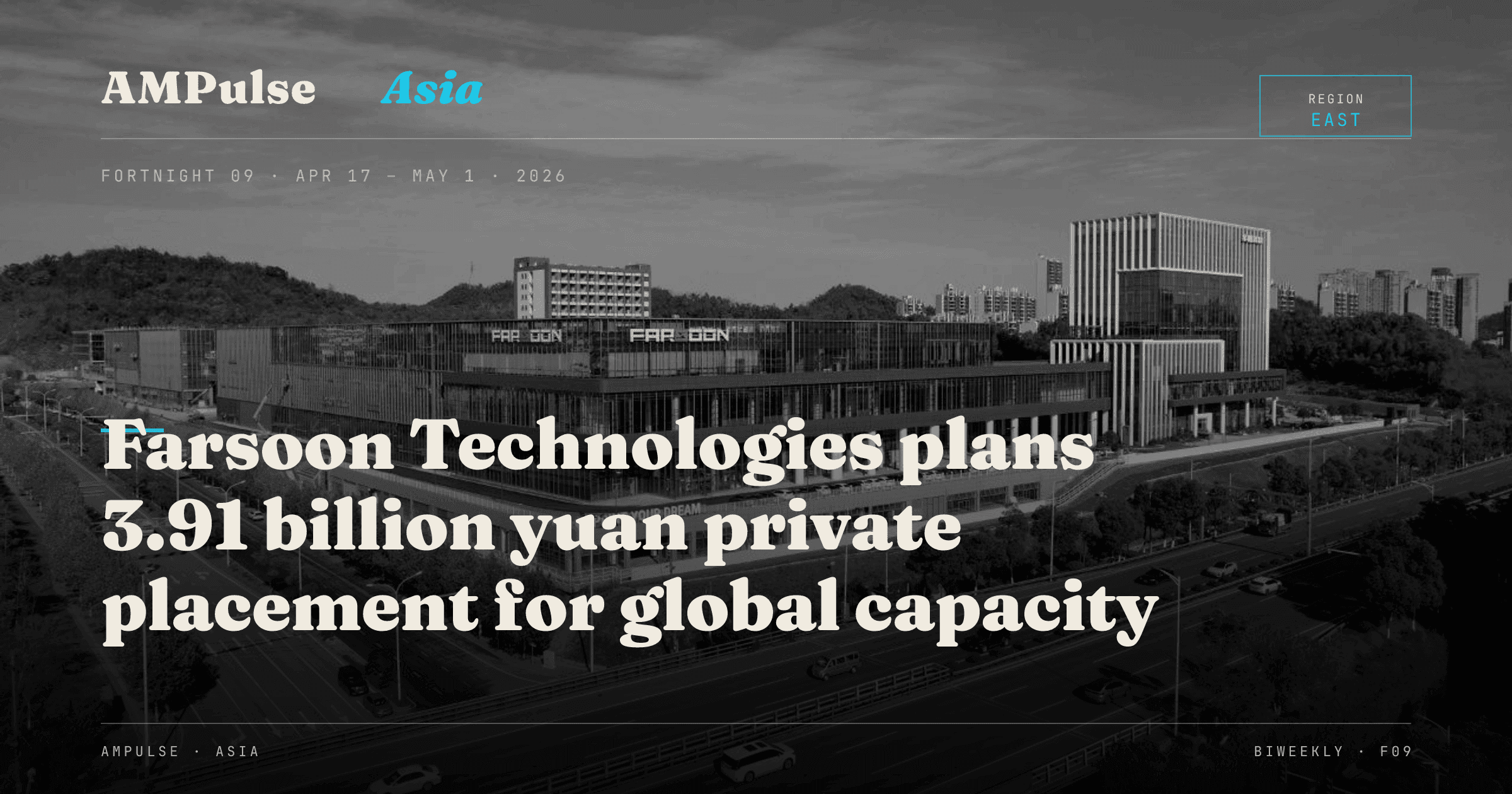
Farsoon Technologies plans 3.91 billion yuan private placement for global capacity
This is the largest equipment-side capital raise in the Asian AM sector for 2026, signaling a structural escalation of the Chinese localization arc into global service and operation centers.
Farsoon Technologies announced a private placement plan to raise 3.91 billion yuan for the expansion of its additive manufacturing equipment capacity, the development of a service platform, and the establishment of new global operations centers. This capital infusion arrives alongside the company's 2025 financial report, which detailed a 715 million yuan annual revenue, representing a 45% year-on-year increase.
华曙高科: Farsoon posts 715M yuan 2025 revenue (+45%) and signs ANZ distribution deal with Emlogic
The manufacturer confirmed that its cumulative equipment sales have surpassed 1,400 units, with more than 800 of those installations categorized as metal systems. These figures complement the company's expanded international reach, which included the signing of a distribution agreement with Emlogic to provide metal and polymer laser powder bed fusion systems across the Australia and New Zealand markets.
This capital raise follows a period of growth for the Chinese Tier S OEM, which has integrated into supply chains for mass-market consumer electronics, including foldable phone hinges and titanium smartwatch components. Farsoon currently maintains an installed base of over 150 large-format metal systems, continuing to compete on price-to-throughput ratios against Western incumbents.
BLT and Farsoon confirm mass production of titanium AM components for OPPO and Honor
Confirms the 'Consumer Electronics Adoption Wave' (Pattern P5) with named Tier 1 mobile OEMs and quantified performance improvements in display flatness.
Xi'an Bright Laser Technologies (BLT) and Farsoon Technologies confirmed the deployment of metal Laser Powder Bed Fusion (LPBF) systems for the mass production of titanium alloy hinges and cases for OPPO, Honor, and Apple. BLT reported that its consolidated titanium hinge for the OPPO Find N6 achieved a 50% improvement in display flatness through part reduction and optimized geometry.
On April 23, 2026, BLT announced the development of the consolidated titanium hinge for the OPPO Find N6, which utilizes additive manufacturing to address screen crease issues and reduce component weight. The project follows BLT’s 2025 preliminary results, which showed revenue of RMB 1.863B, a 40.54% year-over-year increase attributed to deeper penetration into aerospace and consumer electronics (3C) sectors.
Separately, Farsoon Technologies reported on April 26, 2026, that its metal LPBF solutions were utilized for the mass production of titanium alloy foldable phone hinges and watch cases for OPPO, Honor, and Apple. While Apple confirmed 3D-printed titanium adoption for the Watch Ultra 3 and iPhone Air earlier this year, Farsoon’s disclosure provides a specific hardware-provider link to the high-volume production workflows of these Tier 1 mobile OEMs.
In the same fortnight, Han’s Laser reported record 2025 revenue of 18.7B RMB, highlighting a vertically integrated additive manufacturing chain that includes laser sources and metal LPBF systems. This scale of industrial revenue coincides with BLT’s April 20, 2026, groundbreaking on a 1 billion yuan metal powder production facility in Shaanxi, intended to secure the upstream material supply required for million-unit device cycles.
These developments represent the 'Consumer Electronics Adoption Wave' (Pattern P5), supported by prior 2026 milestones including BLT’s delivery of metal 3D-printed parts for BYD’s Yangwang U9 and the formalization of strategic cooperation between BLT and Siemens for digital AM factories. The transition to mass production in the 3C sector follows the pattern of titanium cost-reduction and throughput improvements reaching the parity required for serial manufacturing beyond the aerospace sector.
Notable Developments
- Elegoo - ELEGOO parent Zhinengpai secured a 500M+ yuan ($73M) Series B+ round led by Meituan. This funding, arriving just six months after a DJI investment, targets an upgrade in software-hardware integration for their resin-heavy consumer printer fleet.
- Nuopu Regenerative Medicine - Nuopu obtained China's first Class III medical device registration for an AM-extruded biodegradable bone filler. This represents a major regulatory milestone for bioresorbable implants in the oral reconstruction vertical.
- SeeGene Bio - South Korea's SeeGene Bio received FDA 510(k) clearance for its EASYMADE TI patient-specific titanium implants. The clearance facilitates US market entry for their LPBF-based craniofacial reconstruction workflow.
- HD Hyundai - HD Hyundai partnered with the US Navy's Office of Naval Research (ONR) and Seoul National University for research into large-scale 3D printing for shipbuilding. The direct US funding of Korean teams highlights the expanding defense wave into maritime applications.
- Innospace - South Korean launch provider Innospace partnered with Oqton to integrate AI-driven process optimization into its metal AM production for space launch vehicles. This aligns with the 'technical truth vs. commercial narrowing' pattern seen in Western space startups.
- Bambu Lab - Bambu Lab entered an exclusive retail partnership with Sam's Club China and reported 54% Q1 output growth. This retail expansion signifies the continued 'consumer-electronics pull-through' of desktop FDM into mainstream channels.
- Cyfuse Biomedical - Cyfuse launched clinical trials for 3D bioprinted knee joint cell transplantation in partnership with Keio and Fujita Health Universities. This marks a critical step for clinical bioprinting maturity in the Japanese market.
By Country
🇰🇷 Korea
- Daejeon City - Daejeon City secured 2 billion KRW to support 20 defense and aerospace startups with 3D printing infrastructure, building a domestic AM supply chain.
- Daejeon City - Daejeon City allocated 20 billion won to an accelerator for 20 defense and space startups using 3D printing, bridging prototyping and production.
- Daejeon - Daejeon City secured 2 billion won for a program supporting 20 defense and space startups with 3D printing prototyping, testing, and certification.
- 浦项科技大学 - POSTECH developed a DSML AI framework that predicts LPBF AlSi10Mg part strength with 9.51 MPa error, four times more accurate than existing methods, in seconds.
- AM Plus - AM Plus showcased production AM solutions based on Formlabs Form 4 and Fuse 1+ printers at SIMTOS 2026.
- Daejeon Metropolitan City - Daejeon City secured $2.3 million to support 20 defense and space startups with a 3D printing scale-up program including prototyping, certification, and investment matching.
- Kaist - KAIST researchers developed an interpretable AI framework predicting LPBF part strength from porosity data with a 9.51 MPa error, published in Acta Materialia.
- Pocheon - Pocheon City has partnered with KAIST to develop 3D-printed drone production technology and a specialized defense manufacturing and training base.
🇨🇳 China
- KOKONI - Huawei's Hubble Investment led a funding round in Moxin Technology, a Chinese AI software developer for additive manufacturing.
- Moxin Technology - Moxin Technology added Huawei's Hubble Technology Investment as a shareholder, signaling strategic alignment in AI-driven AM software for China's industrial digitization.
- 武汉睿意新材料 - Wuhan Ruiyi New Materials raised tens of millions of yuan to scale oxide solid-state electrolyte production as part of a RMB 400M incubation program.
- StellarStack - Chinese metal AM startup StellarStack closed a tens of millions RMB angel round to advance SLM technology for aerospace and robotics serial production.
- 哈森唯特 - Hasen-Vite launched TPR titanium powder made from scrap recycling and plasma atomization, aiming for cost parity with stainless steel in AM and MIM.
- Bambu Lab - Huina Technology invested 22.3 million yuan in Bambu Lab 3D printers to build a production farm for cultural and creative products.
- 四川省人民政府 - Sichuan Province's 15th Five-Year Plan designated additive manufacturing as a strategic emerging industry with a full value-chain roadmap and three national AM events.
- Bambu Lab - Bambu Lab launched the X2D dual-nozzle 3D printer with mechanical switching and Dynamic Flow Calibration, starting at $649.
🇯🇵 Japan
- APPLE TREE株式会社 - APPLE TREE's 4D MAKURA LATTICE3000 3D-printed pillow crowdfunded ¥9.39 million on GREEN FUNDING, demonstrating consumer AM for lattice-based comfort goods.
- Hitus - Hitus has launched a 500,000 yen crowdfunding campaign to fund a 2026 design contest aimed at expanding its COCRE HUB digital library of 3D-printable assistive devices.
- DMG MORI - DMG Mori detailed its Lasertec DED hybrid 6-in-1 process and Lasertec SLM series for additive series production, targeting tooling and aerospace.
- ExtraBold - Tokyo-based Extra Bold has patented a Butler-style large-format 3D printing method that uses a robotically controlled moving table and a stationary print head to minimize machine footprint.
- YKK - YKK won a Red Dot Design Award for a 3D-printed zipper puller developed with Variloom, using bio-based TPU and a print-to-shape process.
- Omron - Omron integrates its Sysmac automation platform with Dassault Systèmes' virtual twin technology to bridge IT/OT gaps in industrial production.
Other East Asia
- REVOPOINT INTERNATIONAL LIMITED - Revopoint launched the MetroY Ultra industrial scanner at $1,899 and POP 4 hybrid scanner on Kickstarter, targeting metrology and prosumer markets.
Southeast Asia
- Singapore 3D Printed Concrete Bridge (SG) - Singapore's LTA plans a 10-meter 3D-printed concrete pedestrian bridge by 2028 using segmented post-tensioned construction, with load tests on a half-scale model completed.
Compiled from 39 sources · fortnight covers 2026-04-17 – 2026-05-01.

AMPulse · Asia Biweekly Digest · ampulse.online
Stay Updated
Get the latest additive manufacturing (AM) market insights, company updates, and analysis directly in your inbox.
By subscribing, you agree to receive AMPulse emails and to our Privacy Policy. Unsubscribe any time.