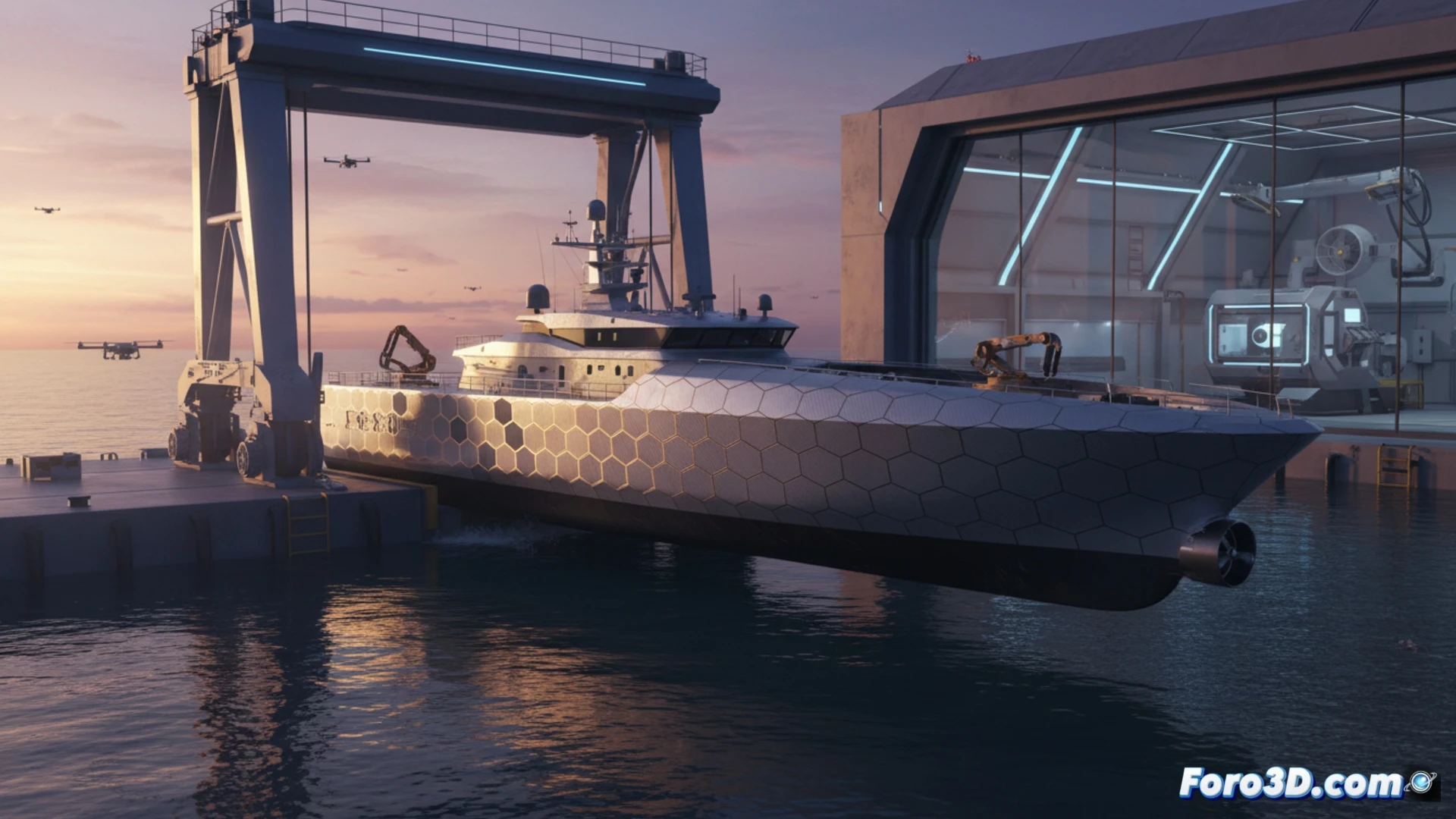
Versatile Marine launches 3D-printed unmanned vessel for surveillance and research

Hardware
Originally reported by foro3d.com
Versatile Marine, an Australian additive manufacturing and maritime systems company, has unveiled a 3D-printed autonomous vessel that combines large-format polymer extrusion with unmanned navigation systems. The vessel is designed for missions including maritime surveillance, oceanographic research, and search-and-rescue operations, where removing crew from hazardous environments reduces risk and operational costs. The company emphasizes that the modular, lightweight hull structure enables rapid customization and on-site part replacement without requiring drydock facilities, and that the additive process generates significantly less material waste compared to conventional shipbuilding methods.
This launch fits a recurring pattern in the AM industry where additive manufacturing is used to lower the barrier to entry for specialized, low-volume platforms - in this case, unmanned surface vessels (USVs). The defense and maritime segments have historically been slow to adopt AM for end-use parts due to qualification burdens, but the unmanned nature of this vessel reduces some of those certification constraints, as the platform itself is not crew-rated. Versatile Marine is positioning itself at the intersection of two growing demand verticals: defense (which has seen politically accelerated adoption in 2025-2026) and energy/ocean research, where long-endurance, low-cost platforms are increasingly needed. The company’s value-chain position is as a system integrator, combining AM-produced structures with off-the-shelf autonomy software and sensors, rather than as a pure printer or materials supplier.
From a practical standpoint, Versatile Marine’s vessel is a credible application of large-format polymer AM for maritime use, but it remains a niche product. The company’s next challenge is moving from prototype and small-series production to repeatable manufacturing at a cost that competes with traditional fiberglass or aluminum hulls. Buyers in defense and research should evaluate the vessel’s seaworthiness data and autonomy reliability before committing to fleet deployment. For now, this is a solid proof of concept that extends AM’s reach into a new application domain, but it does not yet signal a shift in shipbuilding economics.
Topics