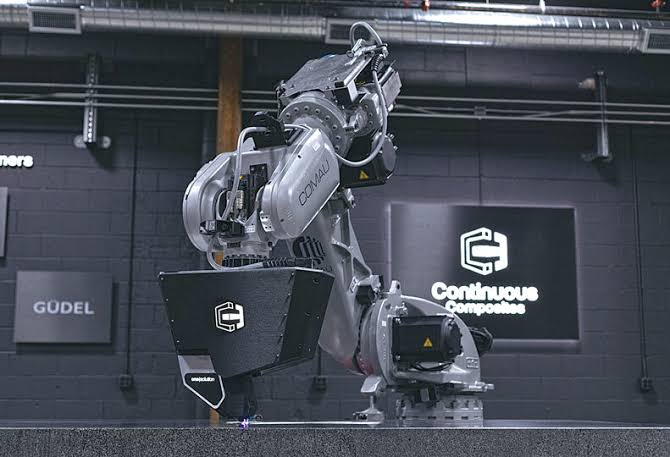
Continuous Composites wins multi-year U.S. Army DEVCOM contract for CF3D missile parts

Hardware
Originally reported by TCT Magazine
Continuous Composites has been awarded a multi-year contract with the U.S. Army DEVCOM Aviation and Missile Center (AvMC) to advance its CF3D continuous-fiber 3D printing technology for missile applications. The work, supported by the Army's Manufacturing Technology (ManTech) program with America Makes as a key partner, will explore applying CF3D to the Precision Strike Missile architecture. Specific targets include nose cones, fins, leading edges, and bulkheads - components that demand high-temperature performance, structural integrity, and accelerated production timelines. CEO Steve Starner stated the goal is to lower program risk and position the technology for scalable production aligned with Department of Defense priorities.
This contract places Continuous Composites squarely within the defense vertical's politically accelerated 2025-26 wave, where the U.S. military is actively seeking domestic, non-traditional manufacturing solutions to reduce supply-chain vulnerability and improve part lead times. CF3D competes in the composite AM space against technologies like Markforged's continuous-fiber FFF and 9T Labs' compression-molded CFRTP approach, but its key differentiator is in-situ fiber steering and thermoset resin systems capable of higher-temperature performance than typical thermoplastic composites. The Precision Strike Missile program is a high-priority, high-volume production program, meaning success here could transition CF3D from a niche prototyping tool into a qualified production process for defense prime contractors. The involvement of America Makes and ManTech signals that the Army is investing in qualification infrastructure, not just machine procurement - a pattern that historically separates serious production adoption from experimental grants.
For Continuous Composites, the practical challenge is moving from demonstration parts to a repeatable, qualified manufacturing process that meets MIL-SPEC requirements for ballistic and thermal performance. The company must demonstrate that its fiber-steered CF3D process can achieve consistent mechanical properties across production runs, not just in lab conditions. If it succeeds, this contract could become the anchor reference that opens broader defense and aerospace adoption. If it stalls at the qualification stage, it joins a long list of AM technologies that showed promise in missile and airframe applications but never cleared the cost-and-certification barrier.
This article is an AI-assisted rewrite of the linked source report. Facts originate from the source; phrasing is AMPulse's. Use Read Original below to verify, or Report an issue if something is wrong.
Topics