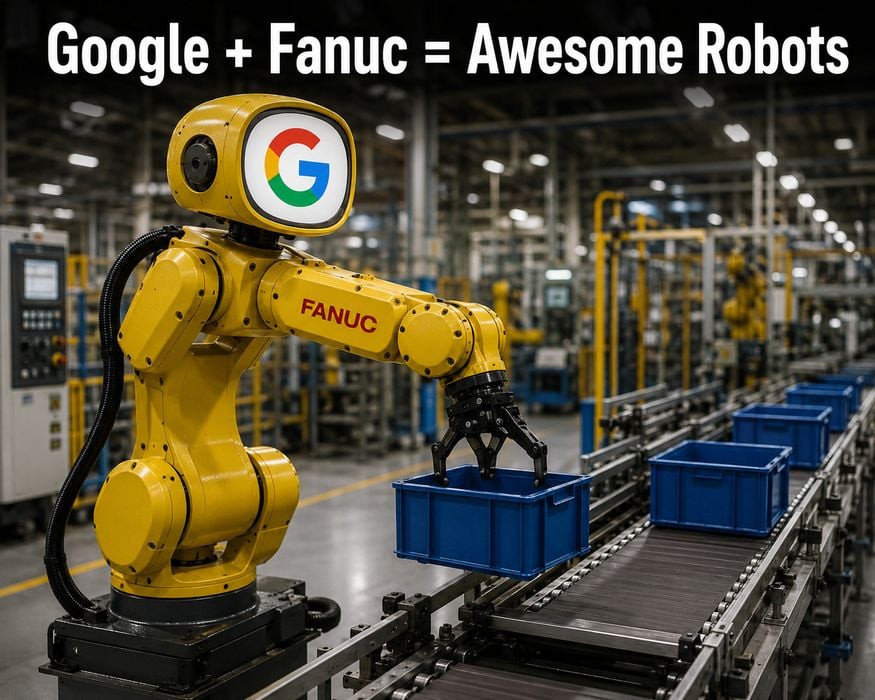
Google and FANUC Partner to Embed Gemini AI into Industrial Robots for Adaptive AM
Originally reported by Fabbaloo
Google and FANUC announced a strategic collaboration in May 2026 to develop "Physical AI" systems for industrial robotics, integrating Google's Gemini Enterprise large language models and Intrinsic robotics platform with FANUC's installed base of over 1.1 million industrial robots. The partnership aims to enable robots to understand natural language instructions, perform real-time computer vision processing, and execute dynamic sensor fusion, moving beyond pre-programmed motion sequences. For additive manufacturing, this means FANUC robots used in robotic material extrusion, DED, or part handling could autonomously adapt to part variations, toolpath changes, or unexpected conditions without manual reprogramming. The companies are targeting deployment in flexible tooling environments where traditional deterministic automation has struggled to deliver ROI.
This partnership represents a significant update to the long-standing challenge of making industrial robots truly adaptive for AM workflows. Historically, robotic AM cells have required extensive engineering support to handle part-to-part variation, material inconsistencies, or changes in build geometry. By embedding multimodal AI directly into the robot control loop, FANUC and Google are addressing the core bottleneck that has limited robotic AM adoption in production environments: the inability to handle unpredictability without human intervention. The deal also marks a strategic pivot for Google, which previously attempted to enter robotics hardware through acquisitions like Boston Dynamics but lacked the industrial deployment network that FANUC provides. For FANUC, the collaboration adds a software intelligence layer that its hardware ecosystem has lacked, potentially creating a moat against competitors like ABB, KUKA, and Yaskawa who are also exploring AI integration but lack Google's model infrastructure.
From a practical standpoint, this partnership's success hinges on whether the Physical AI system can reliably handle the edge cases that arise in real AM production - not just demo environments. FANUC must demonstrate that the system reduces programming time and downtime in actual factory settings, not just in controlled labs. For AM users, the near-term value will likely appear first in post-processing and part handling, where robots currently require frequent reprogramming for different part geometries. The companies should focus on delivering measurable reductions in changeover time and scrap rates in specific AM applications before claiming broader factory intelligence.
This article is an AI-assisted rewrite of the linked source report. Facts originate from the source; phrasing is AMPulse's. Use Read Original below to verify, or Report an issue if something is wrong.