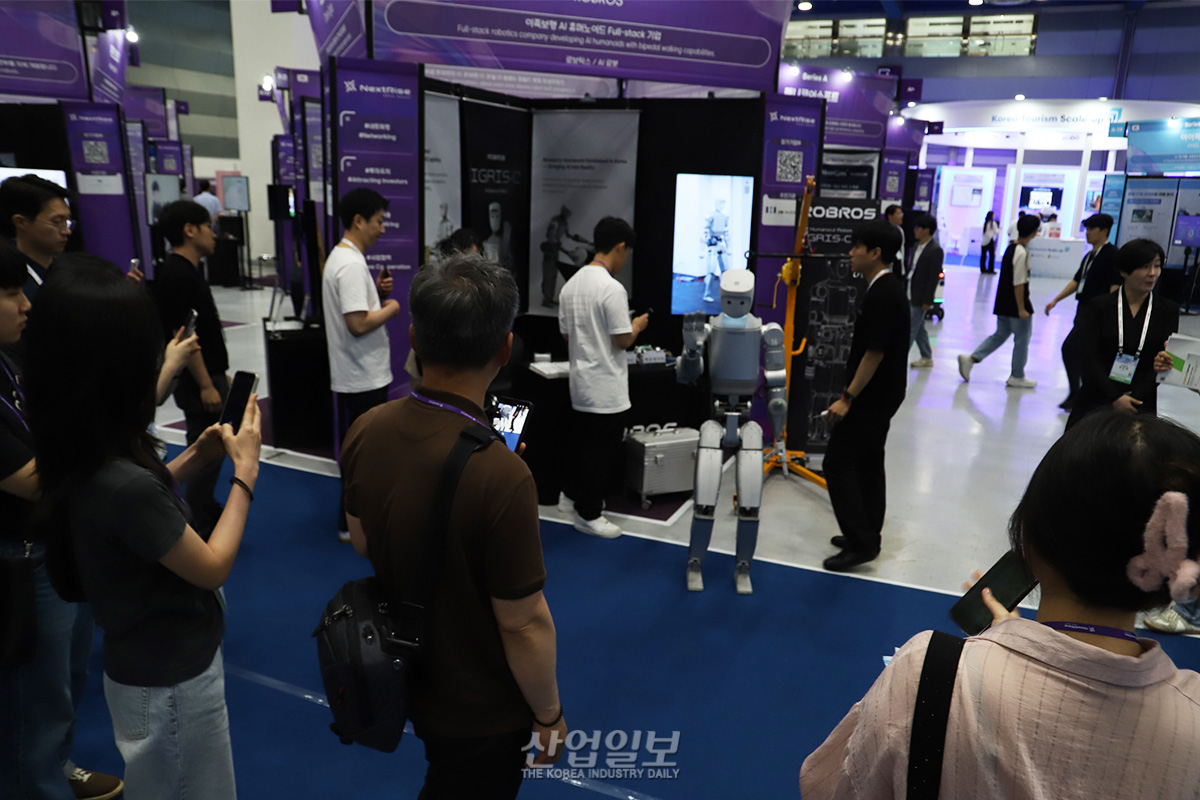
ROBROS targets manufacturing and logistics with bipedal humanoid robot at NextRise 2026 Seoul

Hardware
Originally reported by KIDD
South Korean robotics startup ROBROS showcased its bipedal humanoid robot IGRIS-C at NextRise 2026 in Seoul, alongside announcing an August 2026 launch of the upgraded IGRIS-C Plus model. The IGRIS-C, commercialized in November 2025, was originally developed for service applications but has pivoted to manufacturing and logistics after stronger demand from those sectors. The IGRIS-C Plus will feature a new in-house actuator, increasing payload capacity from 6 kg to 15–20 kg per arm. CEO Seungjun Noh stated that most proof-of-concept projects planned for 2026 are with manufacturing and logistics companies, and that the company builds robots in-house at its Seongsu-dong headquarters to enable customisation per site requirements.
ROBROS is betting on bipedal locomotion as a differentiator in a field where many Korean and Chinese humanoid competitors pair upper bodies with wheeled AGV/AMR platforms. Noh argues that industrial sites are often too cluttered for wheeled bases, and that bipedal robots can operate without modifying existing human-centric infrastructure. This positions ROBROS against global players like Boston Dynamics' Atlas, but the company targets shipyards and logistics warehouses rather than general-purpose applications. The emphasis on payload capacity and durability mirrors the qualification criteria seen in industrial automation procurement, where repeatable performance under load matters more than flashy demonstrations.
For ROBROS, the August launch of IGRIS-C Plus is the critical execution milestone. The company must now convert its PoC pipeline into paid deployments and demonstrate that its sim-to-real reinforcement learning controller can handle real-world variability in shipyards and warehouses. The market will judge the robot not on its walking gait but on uptime, payload consistency, and total cost of ownership relative to wheeled alternatives. A small number of reference installations with measurable productivity gains will carry more weight than any trade show demo.
This article is an AI-assisted rewrite of the linked source report. Facts originate from the source; phrasing is AMPulse's. Use Read Original below to verify, or Report an issue if something is wrong.