KAIST researchers develop AI framework predicting metal 3D printing part strength with 9.51MPa error margin
Originally reported by kbmaeil.com
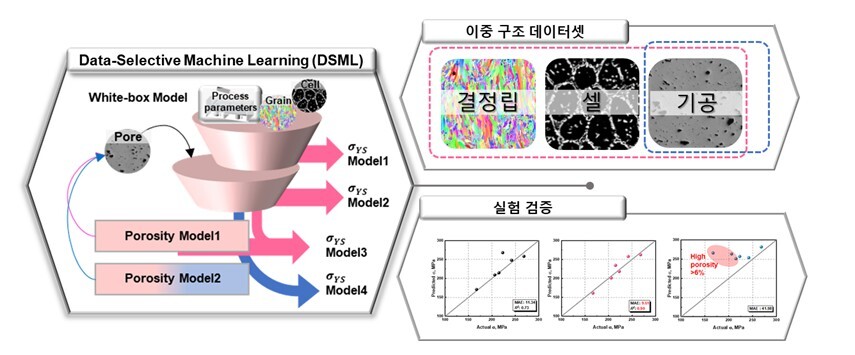
Researchers at Pohang University of Science and Technology (POSTECH/KAIST), led by Professor Kim Hyung-seop and doctoral candidate Lee Jung-ah, in collaboration with Dr. Park Jung-min at the Korea Institute of Materials Science (KIMS), have developed an AI framework that predicts the mechanical strength of metal 3D-printed parts with a mean error of just 9.51 MPa. Published in Acta Materialia, the work applies a technique called Data-Selective Machine Learning (DSML) combined with symbolic regression - an interpretable AI method - to generate human-readable mathematical formulas that correlate pore characteristics with tensile strength. The team validated the model on AlSi10Mg, a common aerospace and automotive alloy processed via laser powder bed fusion (LPBF), achieving a fourfold improvement in prediction accuracy over existing models. Crucially, the framework does not require eliminating defects; it instead learns from them, converting porosity data into predictive equations that can be computed in seconds without physical testing.
This research directly addresses the aerospace qualification grind (Pattern P4), where invisible micro-porosity has long been the primary barrier to certifying LPBF components for flight-critical and safety-rated applications. Traditional approaches rely on extensive destructive testing or expensive in-situ monitoring to bound defect populations; KAIST's method offers a path to reduce that qualification burden by replacing physical test data with AI-generated predictive models. The interpretable formula output - rather than a black-box prediction - is a meaningful differentiator, as certification authorities require physically grounded evidence, not statistical correlations alone. For the broader metal AM industry, which AMPOWER estimates at €11.33B in 2025, this work targets the reliability bottleneck that has kept LPBF adoption concentrated in prototyping and non-critical tooling rather than serial production in aerospace and automotive.
From an expert standpoint, this is a practical step toward embedding AI into the qualification workflow rather than replacing it. The 9.51 MPa error margin on AlSi10Mg is promising but must be validated across a wider range of alloys, build parameters, and part geometries before it can influence certification standards. The next milestone for the KAIST team is demonstrating that the model generalizes to materials like Ti-6Al-4V and Inconel 718, and that the symbolic regression formulas remain stable across different LPBF machine platforms. For now, the work is a solid contribution to the growing body of research linking process-structure-property relationships through interpretable machine learning - a necessary foundation, not a finished solution.
This article is an AI-assisted rewrite of the linked source report. Facts originate from the source; phrasing is AMPulse's. Use Read Original below to verify, or Report an issue if something is wrong.
Topics