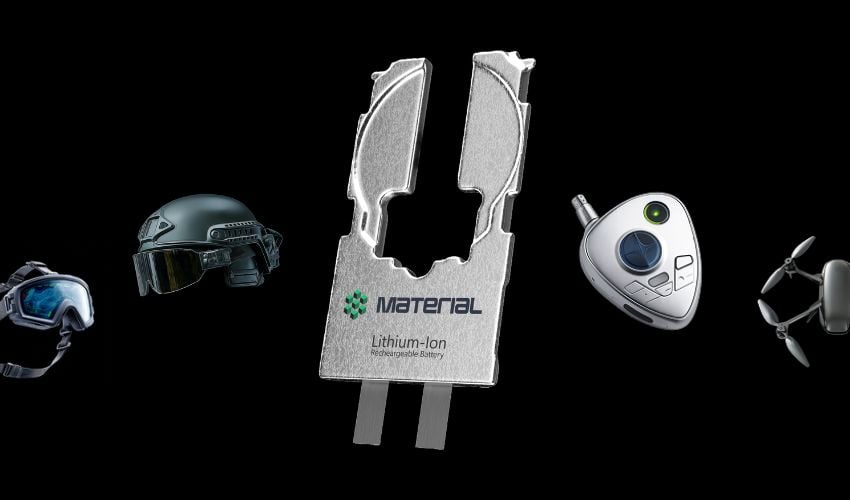
MATERIAL raises $7.1M seed, $1.25M Air Force contract for 3D printed lithium-ion batteries

Hardware
Originally reported by 3DNatives
MATERIAL, a Florida-based startup founded in 2023, has raised a $7.1 million seed round and secured a $1.25 million Air Force contract to commercialize its 3D printed lithium-ion battery technology. The company's multimodal print tool combines FDM/FFF extrusion with direct ink writing of battery slurries and in-situ post-processing, enabling custom-geometry batteries that conform to device enclosures rather than forcing rectangular or cylindrical form factors. CTO and co-inventor Dr. Chris Reyes, whose PhD work at Duke University produced one of the first fully 3D printed lithium-ion batteries, leads the technical effort alongside CEO Gabe Elias and co-founder Miles Dotson.
This development sits at the intersection of two underappreciated AM frontiers: functional material deposition and embedded energy storage. While most AM attention focuses on structural metal and polymer parts, MATERIAL addresses a genuine volumetric constraint in device design - the battery block that wastes interior space. The Air Force interest signals a defense vertical pull for conformal power sources in drones and portable electronics, a segment where weight distribution and shape flexibility directly affect mission performance. The company's claim of collapsing 7–12 conventional battery manufacturing steps into one machine, if validated, would represent a meaningful reduction in capital expenditure and factory footprint compared to traditional gigafactory lines. However, the technology remains early-stage: the seed round is modest, the process description is deliberately vague, and the company has not disclosed energy density, cycle life, or safety test results against commercial lithium-ion cells.
For MATERIAL, the immediate execution challenge is proving that printed batteries meet safety and performance standards for defense and consumer electronics qualification. The Air Force contract provides a structured validation pathway, but the company must demonstrate repeatable electrochemical performance across multiple geometries and material batches. Buyers should treat this as a promising lab-to-production transition, not a drop-in replacement for incumbent cell manufacturers. The real test will come when MATERIAL publishes third-party cycle-life data and ships production-intent units to early adopters.
This article is an AI-assisted rewrite of the linked source report. Facts originate from the source; phrasing is AMPulse's. Use Read Original below to verify, or Report an issue if something is wrong.
Topics