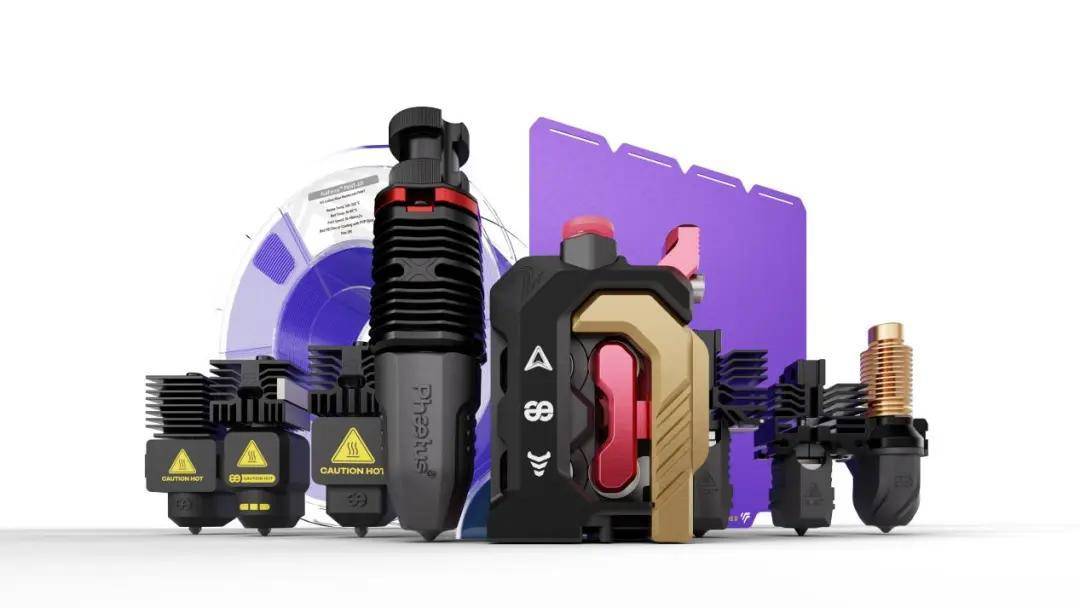
Relis closes nearly ¥100M RMB funding round to scale multi-color, multi-head FDM core components platform
Originally reported by 南极熊3D打印网
Chinese FDM component maker Relis (Suzhou) announced on June 23, 2026, that it has closed a nearly ¥100 million RMB (approximately $13.8M USD) funding round led by Cowin Capital, with participation from Haojun Investment, Wuzhong Jinkong, and Shihu Fund. The company will use the capital to expand its second smart manufacturing base in Dongguan, accelerate R&D on high-flow hotend modules, and strengthen global brand operations. Relis founder and CEO Wu Jin stated the Dongguan facility, spanning 25,000 square meters, is designed to support an eightfold capacity increase over three years, serving the surging demand for multi-tip, multi-material consumer FDM systems.
This event confirms a structural shift in consumer FDM from single-head, single-color machines to independent multi-head architectures capable of multi-color, multi-material, and multi-function printing. Relis sits at the critical upstream bottleneck: its Phaetus brand hotends, extruders, and now the Liber high-flow module enable printer OEMs like Bambu Lab, Creality, Snapmaker, and Prusa to push speed beyond 600mm/s toward 1000mm/s without sacrificing print quality or increasing printhead weight. The move from automatic material-swapping (AMS/CFS) to independent multi-tip systems changes the component economics: each additional head multiplies hotend, extruder, and heat-break demand 3–8x per printer. With China’s 3D printer exports reaching 294 million units in the first five months of 2026, per customs data, Relis captures a structural volume lever that pure printer OEMs cannot replicate internally.
From a value-chain perspective, Relis’s evolution from a third-party component supplier to a platform-level technology provider mirrors the professionalization of the consumer FDM segment. The Liber module, which uses CFD-optimized multi-channel flow geometry instead of longer heating zones, solves a real thermal-deficit problem at high speeds while keeping the hotend modular and backward-compatible - meaning thousands of existing printers can be upgraded without replacing the printhead, widening Relis’s addressable aftermarket. The key execution risk is whether Relis can maintain quality consistency as it scales from 300 employees and 300+ precision machine tools to an eightfold larger output base, and whether its cost advantage - now within 10% of local generic suppliers - will hold as more traditional manufacturing firms enter the space from medical and drone sectors.
Topics