
Written by AMPulse’s research pipeline. Sources are linked inline.
StandardFlow connects project records to qualification requirements. We examine its review workflow, existing alternatives and value for AM engineering teams.
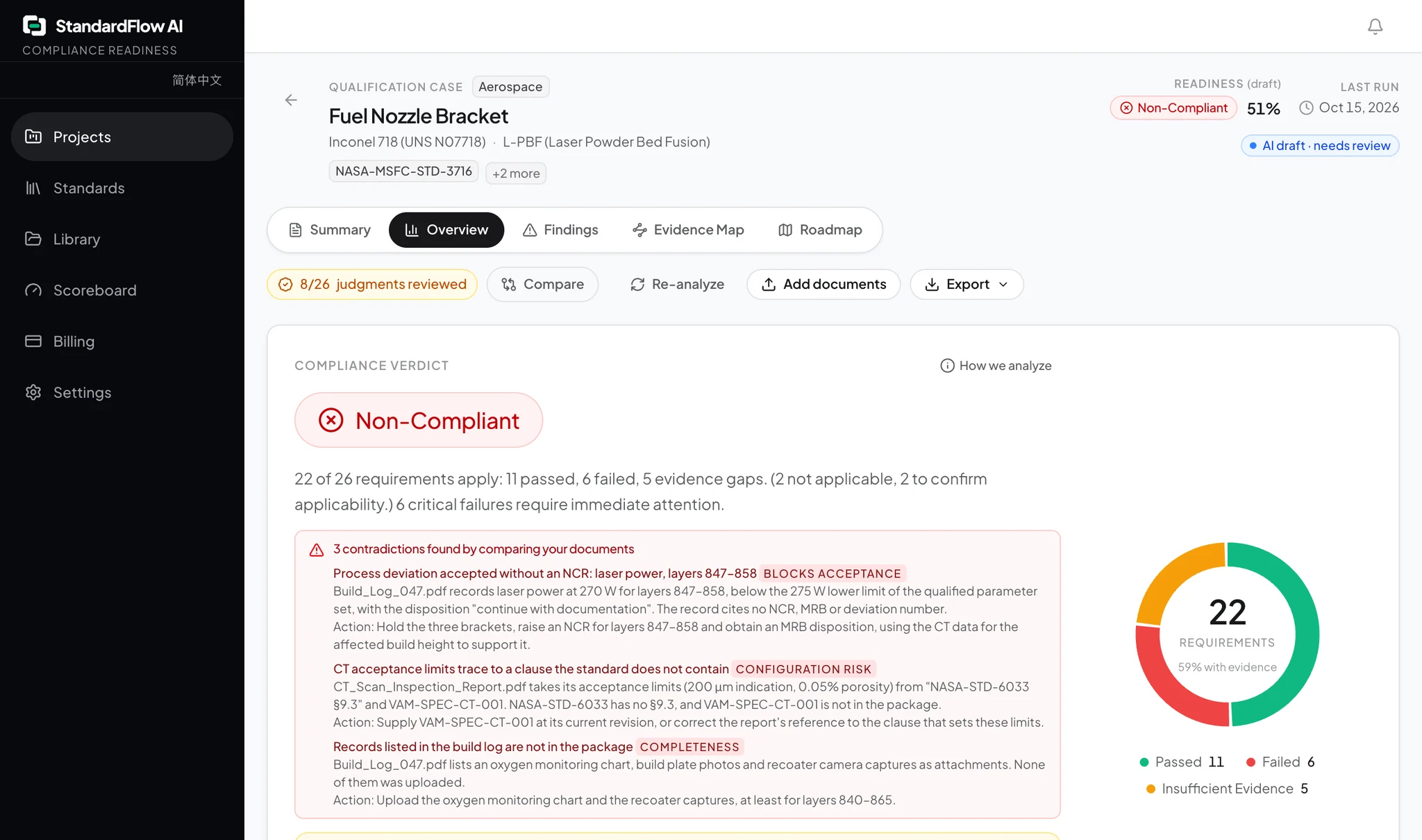
Product image: StandardFlow demonstration interface using synthetic project data.
StandardFlow focuses on turning project documents into a requirement-level evidence review, helping engineers see what is supported, what is missing, and what needs attention before formal submission.
Disclosure: AMPulse is a WeeklyVentures project. StandardFlow is a WeeklyVentures spin-off, and AMPulse editor Sangmin Simon Lee is its co-founder and advisor.
A qualification package can contain a powder certificate, a build traveler, a heat-treatment report and an inspection result, yet still leave important questions unanswered. The records may use different identifiers, refer to different revisions, or leave the connection between a test result and a production part unclear. Establishing those relationships takes engineering work.
StandardFlow has officially launched, led by CEO Michael Molitch-Hou, to support that review. According to its public product description, teams upload technical documents, select applicable standards and receive requirement-level assessments with source citations and evidence gaps.
Its reason to exist is the work between having records and presenting a defensible case for acceptance. For teams assembling evidence from suppliers, laboratories and internal departments, the intended benefit is less time reconstructing which records support each requirement and more attention on the issues that need an engineering decision.
That is a specific review task within AM qualification. Existing systems already manage substantial parts of production, quality and traceability. StandardFlow's proposition is a focused workflow that begins with the package a team needs to assess.
A requirement needs evidence in the right context
Supplier qualification, machine and process qualification, part qualification, and lot acceptance address different questions. NIST's 2023 publication on AM data integration describes these aspects and the information needed across product, material and machine lifecycles.
The difficulty is contextual. A tensile result may describe the correct alloy but a different material condition. A report may reference a drawing revision that no longer controls the job. A powder certificate can be valid while its connection to the production build remains unresolved.
Applicability comes first. NASA-STD-6030, for example, addresses NASA spaceflight hardware, with tailoring guidance for non-crewed missions. Its published baseline separately addresses digital-thread records in Section 4.13, part acceptance in Section 4.18, and qualified material processes in Section 5. Appendix A provides a requirements compliance matrix and recognizes that not every requirement applies to every mission.
A useful assessment follows a chain:
Requirement → project applicability → relevant record → evidence sufficiency → reviewer action.
Finding a paragraph that repeats a requirement does not establish that it was met. A missing record identifies a gap in the reviewed package; it does not establish that the physical activity was omitted. The value of an automated review depends on preserving those distinctions.
StandardFlow connects the package to the review decision
The product's starting point is the technical documentation available for a project. Its AM workflow description identifies powder chemistry and lot traceability, build and calibration records, heat treatment, HIP, and inspection/test reports as evidence areas.
The workflow brings three useful elements together. It maps documents to selected requirements, makes missing evidence explicit, and shows the reasoning and sources behind an assessment. This gives the engineer a structured starting point for checking coverage and resolving gaps.
StandardFlow also describes separating deterministic numeric checks from contextual AI review, with the method and confidence visible for each requirement. This matters because numerical precision and contextual validity are separate problems. Comparing a tensile value with a limit is useful only after establishing the relevant material condition, units, limit and record identity.
The home page describes support for internal or custom requirements and exports for engineering review. The company's NASA-STD-6030 readiness workflow places engineers in the role of confirming, challenging or resolving findings before formal review.
Together, these features define the value proposition: turn a set of technical records into an inspectable assessment of requirement coverage, with unresolved evidence and review decisions made easier to locate. The differentiation rests on how effectively this combined workflow serves that task.
From a document packet to an actionable review
Consider a hypothetical metal powder-bed-fusion component package containing a powder certificate, build traveler, heat-treatment report, material test report and inspection report.
The traveler connects the powder lot to the build and produced serial numbers. The heat-treatment record identifies a furnace batch, but the reviewed package does not show which serials it covered. The inspection report references a drawing revision that differs from the one specified for the job.
A useful assessment would do more than flag an incomplete package. It would make the review actionable:
- An unresolved batch-to-part link. Point to the relevant traveler and heat-treatment record, identify the missing connection, and ask for the record establishing which serials received the treatment.
- A revision conflict. Identify the drawing revisions cited in the inspection record and job requirements, so the engineer can establish which acceptance criteria apply.
- A material-condition question. Where a test report and requirement specify different conditions, place those references together so the reviewer can determine whether the test is relevant or additional evidence is needed.
This hypothetical illustrates the output an engineering team should look for when evaluating StandardFlow or another evidence-review tool. It turns a broad concern about documentation into a small set of traceable questions and follow-up actions.
That is where a focused review workflow could save effort. Engineers would spend less time searching for relationships and reconstructing the issue for the next reviewer, while retaining responsibility for deciding whether the evidence is sufficient.
Where existing tools fit
The underlying problem is established. NIST researchers connected AM data provenance and traceability to qualification in 2017. The 2023 publication describes PLM capabilities spanning documents, requirements, changes and quality workflows, and MES capabilities including process history and component/material genealogy.
The following comparison reflects vendors' public documentation reviewed in October 2026.
On smaller screens, scroll the table horizontally to view all columns.
| Solution | Documented role relevant to evidence review | Question for a prospective user |
|---|---|---|
| Authentise Flows | Manufacturing workflows, machine monitoring, configurable rules, QA reporting, traceability and enterprise-system integration. | How well do the production records and controls already support our review process? |
| Materialise QMS within CO-AM | AM-specific QA/QC, controlled documentation, nonconformance management, corrective/preventive actions, Certificates of Conformance and Data Books. | Can our existing quality workflow assemble and present the required evidence package? |
| Ansys Granta MI for AM | Consolidation and control of machine, material and simulation data, with material traceability across the process. | Is the immediate difficulty organizing material/process data, reviewing received records, or both? |
| Jama Connect | Requirements-to-verification traceability, controlled reviews, baselines and change impact; AI-assisted requirement refinement and test-case generation. | How readily can received records enter the established requirements and verification structure? |
| Accuris Engineering Intelligence | Standards access and AI assistance; traceability for enabled content and change analysis. Enterprise adds internal/customer content, requirements management, gap analysis and governance. | How well does this broader offering address our standards-content and project-review needs? |
| StandardFlow | Project-document review against selected clauses, evidence-gap findings, and visibility into assessment method, reasoning and confidence. | How readily can the records we have become a source-linked assessment of requirement coverage? |
Accuris is a particularly relevant comparison. Its AI Assistant provides citation-backed answers from licensed, publisher-approved standards inside Engineering Workbench and Thread. Its Enterprise offering also includes gap analysis. Those capabilities overlap with the task StandardFlow addresses.
The choice depends on the team's starting point and the work it needs to complete. An existing platform may already provide the right tools, particularly where requirements and production records are well connected. A focused package-review application is worth evaluating where assembling and assessing received records remains a separate engineering task. This is a question of workflow fit, rather than an assumption that one product replaces the others.
Measure the value through a completed review
The same standard should apply to every option: how much engineering effort is needed to reach an acceptable evidence package, and how reliably are consequential gaps identified?
A representative trial should include a correct package, deliberately incomplete evidence, and realistic revision or identity conflicts. Teams should compare the proposed workflow with their current review method and assess:
- Total reviewer effort, including time spent checking findings, correcting errors and preparing follow-up requests.
- Significant missed gaps and false alarms, judged against an engineering-reviewed reference.
- Traceability, from each finding to the applicable requirement and relevant source record.
- Change handling, including what happens when a document or revision changes.
- Operational fit, including required standards and editions, access controls, usable exports and acceptance by the responsible engineering authority.
The product pages describe StandardFlow's intended workflow; measured accuracy and review-time savings need validation on representative project records. That is the evidence needed to assess its economic value.
StandardFlow's reason to exist is concrete. Engineering teams need to explain how their project records support an acceptance decision, including where the connections remain incomplete. Its proposition is to make that assessment easier to assemble, inspect and resolve before formal submission. For teams doing that work across multiple sources, this is a useful place to apply automation while keeping engineering judgment at the center.
Stay Updated
Get the latest additive manufacturing (AM) market insights, company updates, and analysis directly in your inbox.
By subscribing, you agree to receive AMPulse emails and to our Privacy Policy. Unsubscribe any time.