Campus Tirol Motorsport 3D prints 580-gram air-cooled electric motor housing for Formula Student

Originally reported by 3Druck
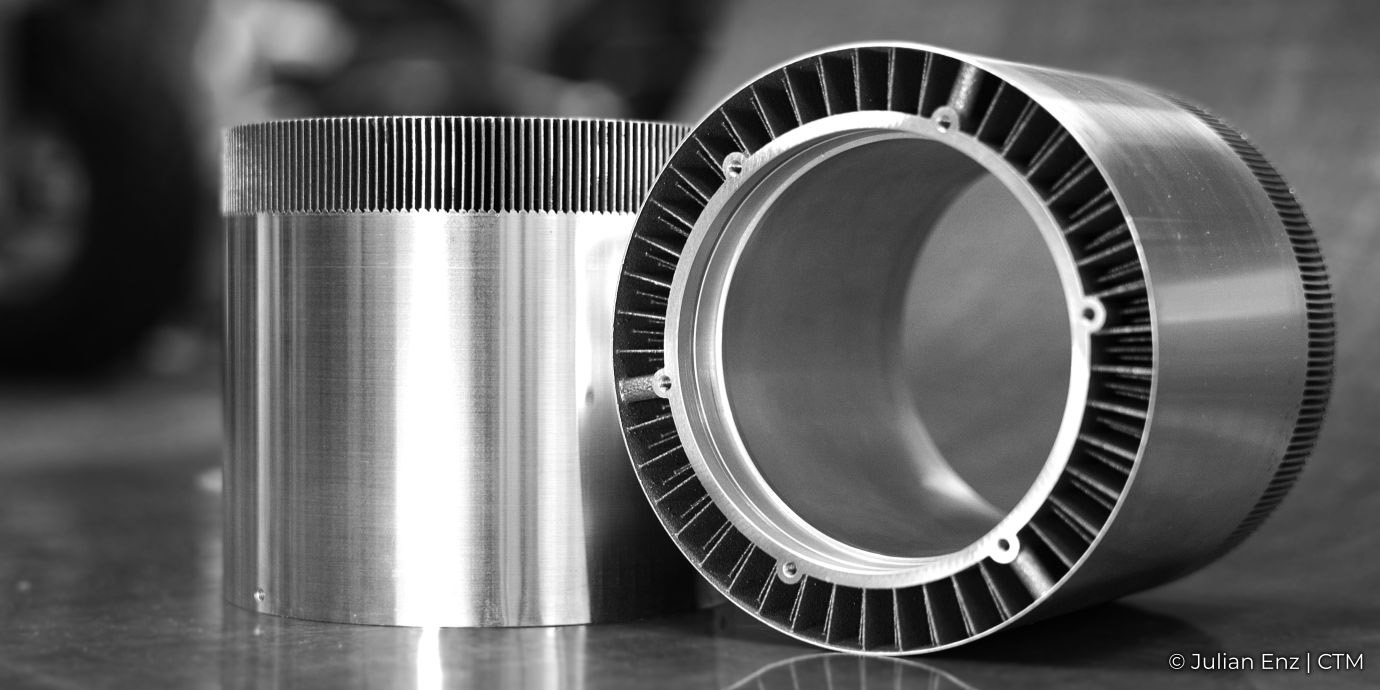
Campus Tirol Motorsport (CTM), the Formula Student team based in Innsbruck, Austria, has developed an air-cooled electric motor housing produced via laser powder bed fusion (LPBF) that weighs just 580 grams. The housing encloses a 35 kW peak-power electric motor with 30 Nm maximum torque and integrates air cooling directly into the geometry through finely executed cooling fins with wall thicknesses down to 0.50 mm. The part was manufactured from AlSi10Mg aluminum alloy by MonaLab and MATERIA, with structural design by the CTM team. By eliminating separate liquid cooling circuits, pumps, and lines, the component consolidates load-bearing structure and thermal management into a single unit.
This project is a textbook demonstration of functional integration in metal AM, where lightweighting, thermal performance, and design for manufacturability converge in a single part. For the Formula Student competition, where every gram saved and every eliminated interface yields a performance advantage, the 580-gram housing represents a meaningful engineering achievement. The thin-wall fin geometry - at 0.50 mm - is sensitive to laser energy input and requires coordinated scan strategies for reliable production, highlighting the process-control discipline that separates capable LPBF users from casual adopters. While this is a student-team project rather than a commercial product, it mirrors the same value-chain logic seen in motorsport and aerospace: AM enables part consolidation and topology-optimized cooling that cannot be achieved with conventional machining or casting.
From an industry perspective, this case reinforces that the frontier of metal AM adoption is increasingly about design intelligence and process repeatability, not just machine capability. The team's ability to produce sub-millimeter cooling fins in AlSi10Mg at production quality shows that LPBF process maturity has reached a point where even student teams can execute advanced thermal-management geometries. The practical takeaway for the broader AM ecosystem is that the barrier to entry for functional integration has lowered - but only for those who invest in scan-strategy expertise and build-process optimization. For CTM, the next step is translating this design approach into a reliably reproducible part under race conditions.
This article is an AI-assisted rewrite of the linked source report. Facts originate from the source; phrasing is AMPulse's. Use Read Original below to verify, or Report an issue if something is wrong.
Topics