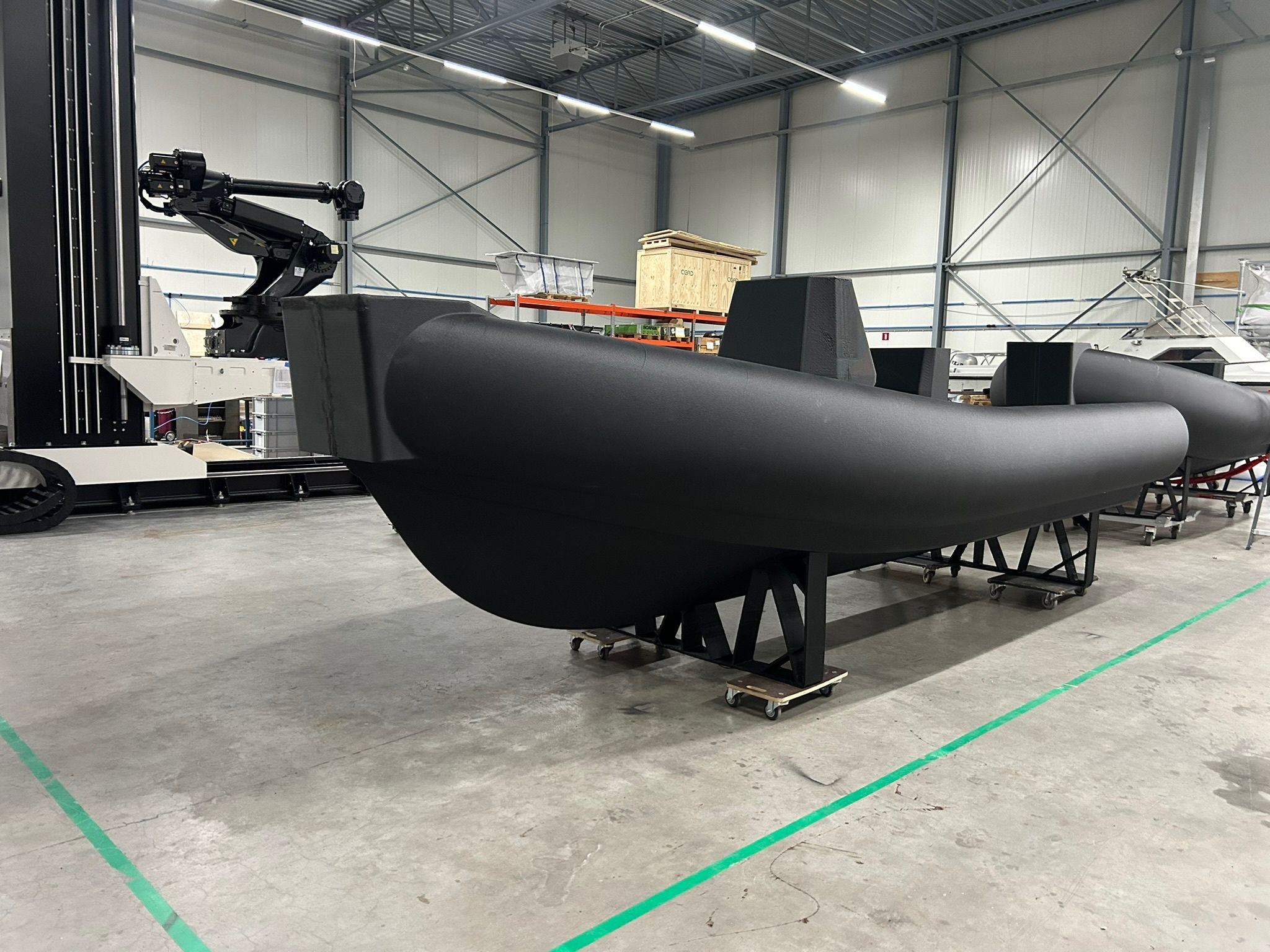
Voltage Vessels submits 3D-printed basalt fiber composite military boat hull for U.S. maritime defense evaluation

Materials
Originally reported by 3D Printing Industry
Voltage Vessels, a Hawaii-based startup founded by Sam Young, has submitted a six-meter rigid hull inflatable boat (RHIB) hull printed from basalt-fiber composite to the U.S. Navy for evaluation. The hull was produced using CEAD's large-format additive manufacturing system and is made from Eclipse X9, a material combining recycled PETG with chopped basalt fiber. External testing at the University of Maine's Advanced Structures and Composites Center reported tensile strength of 108 MPa along the print direction, bending strength of 112.98 MPa, and over 90 percent strength retention after 24 months of saltwater immersion. The submission marks the company's first entry into formal defense evaluation, targeting integration into autonomous naval programs.
This submission sits at the intersection of two accelerating currents in additive manufacturing: the defense sector's push for domestically produced, rapidly deployable platforms, and the materials discipline required to replace metals in marine environments. The Eclipse X9 material offers a combination of structural performance, saltwater resistance, and RF transparency that aluminum and carbon fiber cannot match, a critical advantage for unmanned surface vessels that rely on radar and communications. Equally significant is the distributed manufacturing model Voltage Vessels proposes - printing hulls from digital files at regional facilities across the Indo-Pacific rather than shipping from fixed U.S. yards. This aligns with the Department of Defense's strategy to shorten supply chains and reduce forward-deployment logistics burdens, but it will require passing the Navy's qualification gauntlet, a process that historically takes years even for mature materials.
For Voltage Vessels, the path forward depends on rigorous test data from the Navy's own evaluation protocols and the ability to scale production from a single demo hull to a repeatable process across multiple print sites. Competitors like HADDY and Blue Ops are already pursuing similar large-format AM for military vessels, so Voltage Vessels must prove not just material performance but also cost parity and production reliability under defense procurement timelines. The basalt fiber source - a volcanic mineral abundant in Hawaii - adds a local-supply argument that could resonate in Pacific theater logistics, but only if the material clears Navy qualification standards. For now, this is a credible first step in a long qualification cycle, not a near-term deployment.
Topics